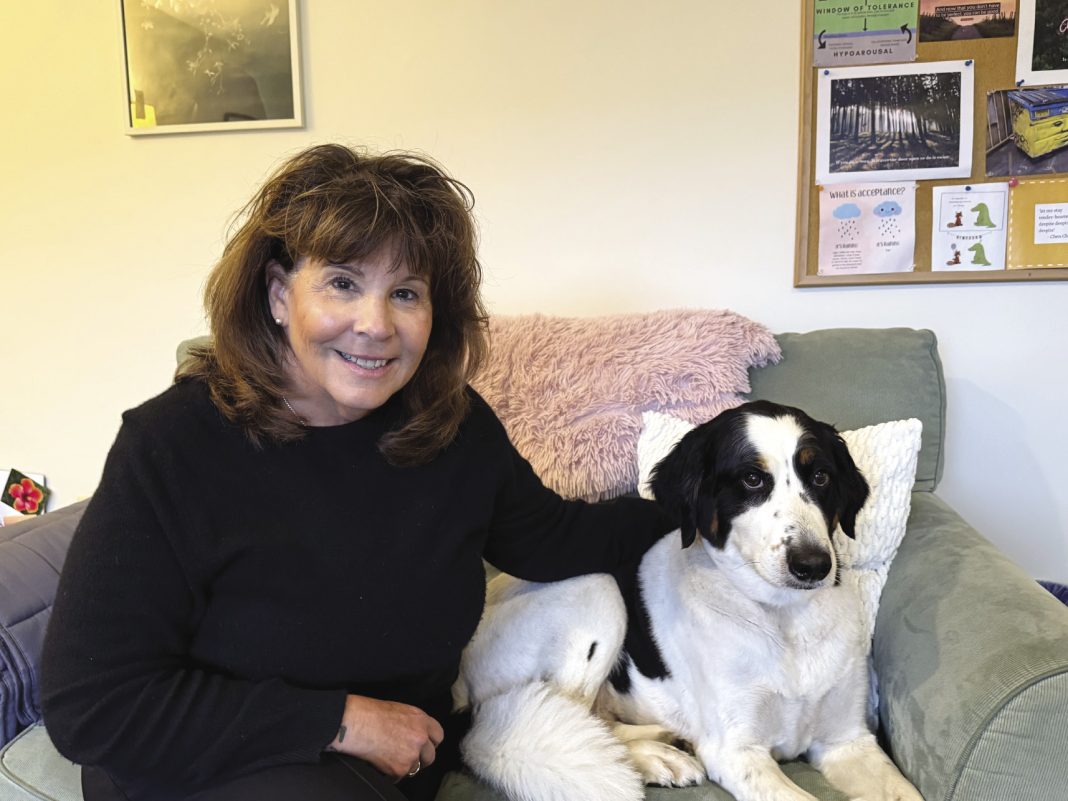
One of the very few things that irritates Dianne Walsh is when her staff call her boss.
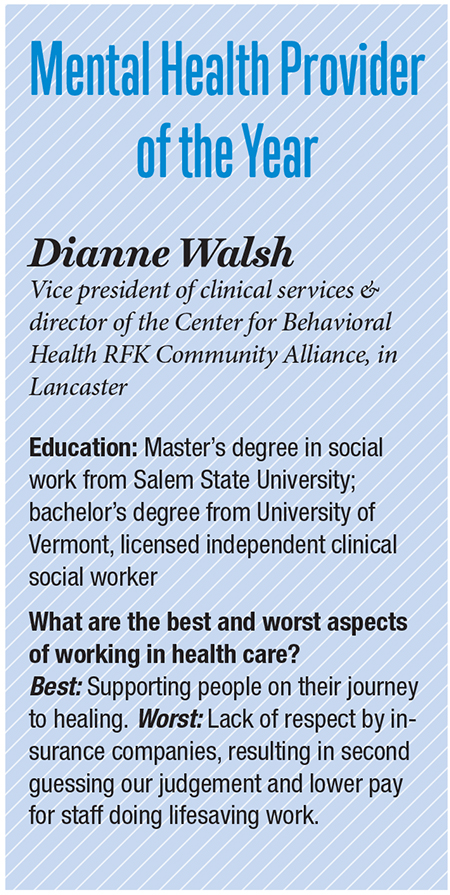
Walsh oversees 27 clinicians, managing five directly, as the vice president of clinical services & director of the Center for Behavioral Health at RFK Community Alliance in Lancaster – meaning there’s quite a few who would understandably assign Walsh that title.
“I look at it as, a boss is sort of hierarchical. And we’re colleagues, and that means we’re a team and we’re a community, as opposed to having there be steps,” she said.
This collaborative lens is part of Walsh’s greater trauma-responsive approach to both her work with clients and fellow employees.
While trauma-informed care acknowledges trauma and its impacts on one’s life and choices, a trauma-responsive approach provides proactive care using an understanding of the lasting impacts of trauma.
For example, Walsh will request construction not take place at the center while providers are seeing patients.
“Loud noises, or things they don’t expect, will impact anybody with trauma. So it’s sort of that lens all the time, not just about a certain person … but it’s also certain things we do or don’t do as we move through the world,” said Walsh.
This forethought and influence sets Walsh apart, said Kathy Mills, president and CEO of RFK.
Walsh shows up, said Mills, which is an easy thing to say, but she means it.
“She shows up in programs that are hers. She shows up in programs that aren’t hers. She shows up for all staff,” said Mills. “She wants to be there to hear the other person’s voice, hear what their concerns are, problem solve with them. She’s really exceptional.”
When Walsh assumed her role of VP, she spent that first year sitting with every leader and group of clinicians at RFK, listening and asking questions, not assuming she had all the answers.
When the agency is making big decisions, she meets with clinical leaders to see how those potential decisions could impact their work.
“If there are decisions to be made, she is one of the people who is highlighting the voices who we might be missing out on to be part of that decision-making process,” Mills said. “She’s a very active participant and invites other people to the table, which is exactly what we want to do in our work.”
“They know things I don’t know,” said Walsh.
It’s not just during big decisions that Walsh seeks the input of others. She leads bimonthly team meetings with the Center for Behavioral Health, monthly meetings with clinical leaders as a group, and once a month with them individually, on top of meeting with all clinicians across the agency together once a quarter.
“It’s really important for me not to hold all the reins … I tell people all the time, ‘You don’t need my permission, as long as nobody gets hurt,’” Walsh said with a laugh.
But her collaborative nature in no way suggests she doesn’t take charge and propel the agency forward.
In one of her most recent heavy lifts, Walsh led the effort to transition RFK’s group practice into a licensed clinic, which will be licensed and overseen by the Massachusetts Department of Public Health.
As is, all clinicians at the organization’s group practice must be individually licensed, meaning the practice can’t take on interns, those completing practice hours to sit for their licensing exams, or those who are not licensed independently.
Becoming a licensed clinic will mean RFK can utilize those willing and able employees to help meet the mounting mental health crisis and staffing shortage facing the region.
“We’ll be benefiting the entire field,” said Naomi Reville LeBlanc, RFK’s associate vice president of strategic communications. “Some of them will inevitably move on to other places, but we’re also benefiting the North Central region where people can access us.”
While the practice hasn’t needed to do much to ensure its policies and procedures are in line with the DPH, Walsh has still had considerable work to do to align its processes with the state agency’s requirements, including those related to intake, referrals, grievances, performances, and assessments.
Furthermore, the practice’s building had to become Americans with Disabilities Act-compliant, which was completed in March. RFK submitted its application to DPH on Oct. 8.
“Diane sets the tone for the level of therapeutic work that we do and the level which we’re willing to go to,” said Mills.
Mica Kanner-Mascolo is a staff writer at Worcester Business Journal, who primarily covers the healthcare and diversity, equity, and inclusion industries.

