
When Shanan Stratis talks about her career in nursing and education, the first word that comes to mind is care.
For nearly three decades, Stratis has built her work around caring for patients, students, and the Greater Worcester community. Today, as assistant dean of healthcare at Quinsigamond Community College, she leads the college’s programs in a way that reflects both compassion and innovation.
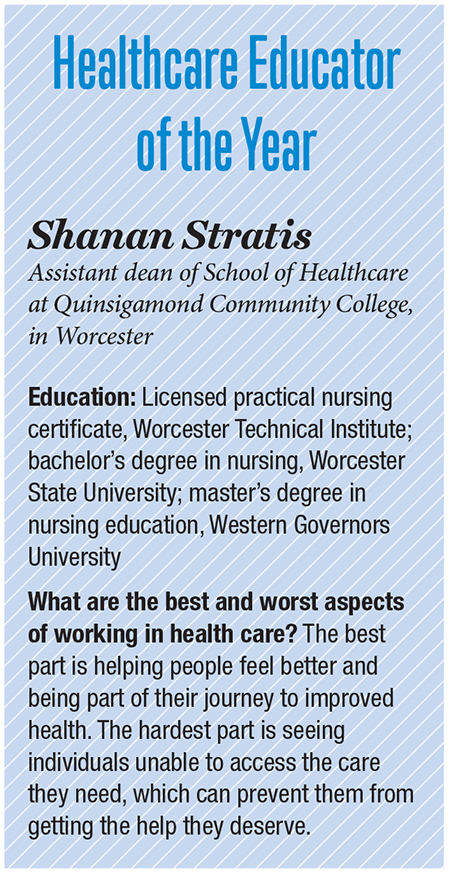
“I’ve always wanted to care for people,” she said. “Caring for others is incredibly meaningful and personal, and when someone trusts you with their health, it’s a tremendous responsibility and an honor.”
Stratis began her career as a licensed practical nurse, later returning to school to become a registered nurse and earning a master’s degree in nursing education. Over her years at Quinsigamond Community College, she has served as an adjunct faculty member and director of a nearly $2-million four-year federal grant supporting underrepresented nursing students. She now oversees all of the college’s healthcare programs.
QCC’s numbers reveal the scale and diversity of her work: as of 2023, the college enrolled 6,930 students, of whom only 28.2% were fulltime. More than 42% of the student body identified as white, 24.1% as Hispanic or Latino, and 15.8% as Black or African American. The average net price paid by students after financial aid was $7,392 in 2023. That backdrop of diversity and financial challenge helps explain why Stratis emphasizes studentcentered leadership.
When she directed the federal Health Resources and Service Administration grant at QCC, the aim was clear: support students with economic obstacles, first-generation college backgrounds, or lower GPAs so they could successfully transition to a bachelor’s degree in nursing program.
“Many of those students went on to graduate, earn master’s degrees, and even return to QCC as faculty,” said Pat Schmohl, dean of School of Healthcare at Quinsigamond Community College. “Shanan turned compliance into a learning opportunity.”
That experience advanced the supportive, studentfirst approach that Stratis now brings to administration.
“I always put students first and understand the challenges communitycollege students face balancing fulltime jobs, families, and school,” she said. “So I focus on being supportive and present for them in any way possible.”
Under her leadership, QCC has revamped its healthcare training facilities with advanced simulation labs.
“Technology in healthcare changes constantly,” Stratis said. “We now have highfidelity manikins that breathe and talk. We even have a simulation ambulance that’s the same size and setup as a real one.”
These upgrades allow students to practice critical interventions in controlled, realistic settings before entering clinical care.
Stratis’s role was pivotal in obtaining funding and shaping the lab expansion, said Schmohl.
“During COVID-19, our equipment was outdated, and we had only one working ventilator,” he said. “Now, thanks to her efforts, our labs are modern and fully equipped. Students are practicing on the same machines they will encounter in hospitals.”
Stratis places emphasis on inclusion. She led revisions of QCC’s technical standards to make programs more welcoming to students with disabilities while maintaining rigorous expectations.
Facing workforce demand, Stratis helped revive QCC’s respiratorycare program, which had been facing low enrollment despite regional need. With outreach and program development aligned to industry, the program now has full enrollment and a waitlist. Under her guidance, students are being placed in partner hospitals and clinics, many of which hire them upon graduation.
She is “intelligent, thoughtful, studentcentered and deeply compassionate,” Schmohl said. “You can feel the energy when you walk into the labs now. Students are engaged, faculty are excited, everything feels alive.”
For Stratis, the recognition she has received reflects more than her own work.
“It doesn’t just belong to me. It belongs to every patient, coworker, and mentor I’ve had,” she said. “Every person and experience has shaped my career.”
And training the next generation of healthcare professionals is going to be vital for the industry to thrive.
“We’ll always need compassionate individuals to care for others,” she says. “That’s what it’s all about.”
Charlotte Powers is a fall editorial intern for the Worcester Business Journal. She is a junior at College of the Holy Cross and studies political science, with a minor in environmental studies.

