The battle between medicine and cancer is ongoing. However, an almost bigger battle lies between people and recognizing possible symptoms.
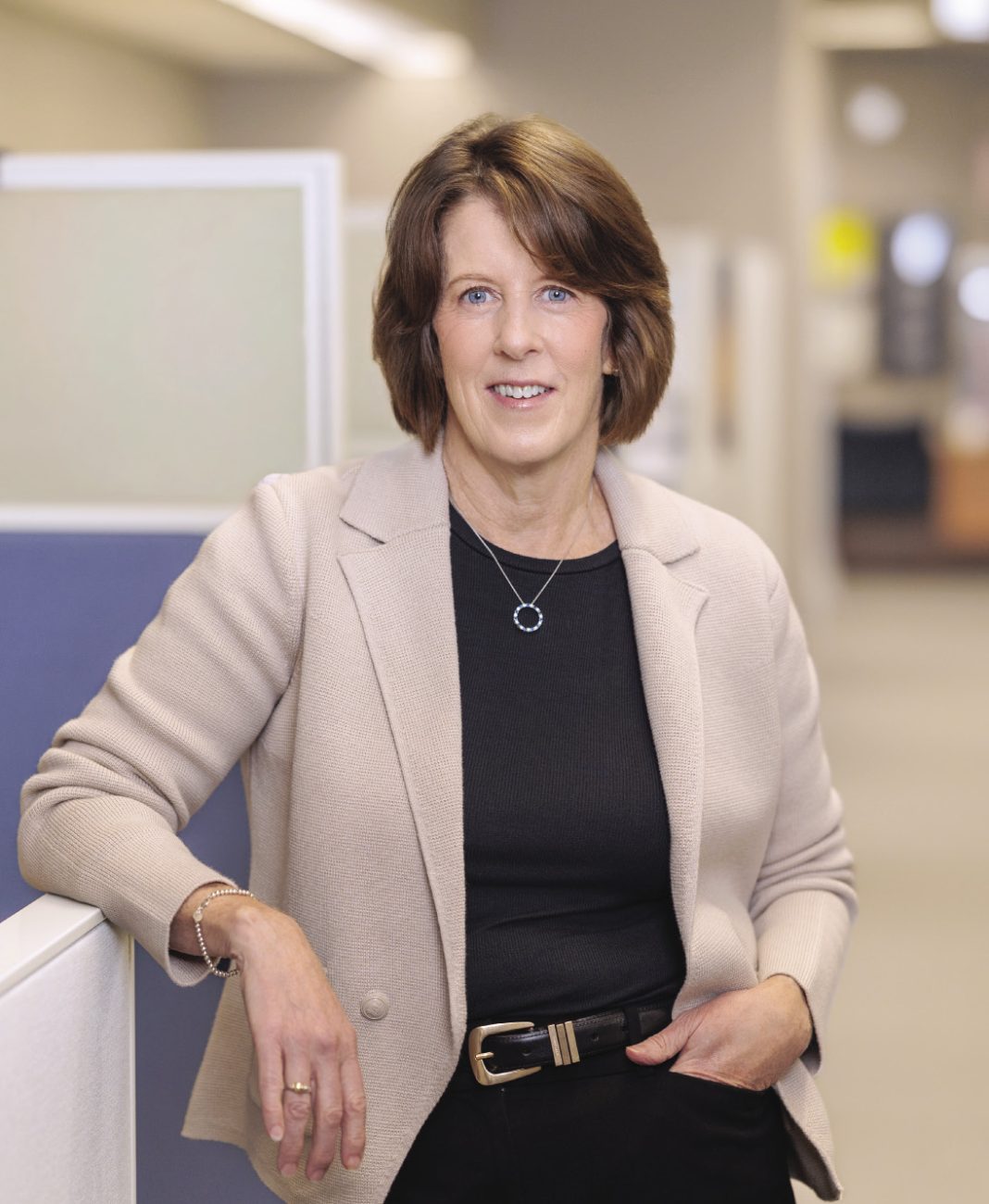
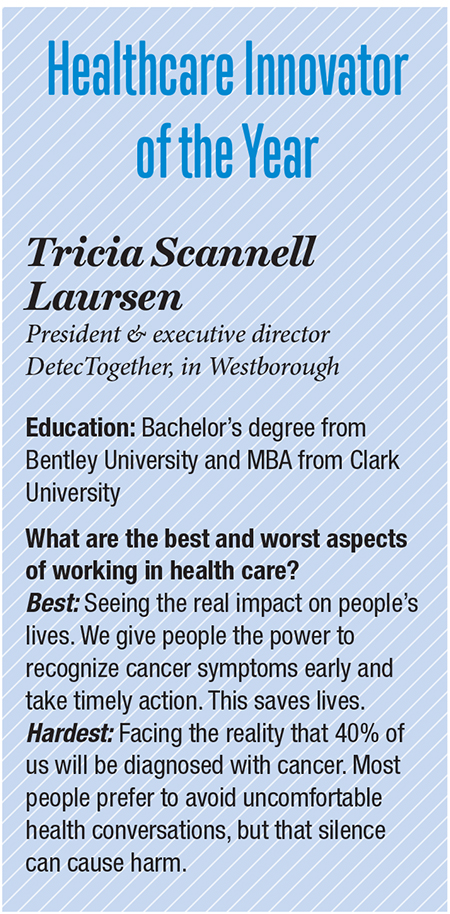
Tricia Scannell Laursen has been with DetecTogether for 16 years, now leading the Westborough-based nonprofit as president and executive director. She has tested the challenge of delayed cancer diagnosis and found success through educational programs.
Scannell Laursen was struck by the passion of the nonprofit’s co-founder, Jim Coghlin, and had experienced loss within her own family due to delayed diagnosis, which motivated her to do this type of work.
“She’s smart. She’s patient. She’s a real coach, leader, and mentor,” Coghlin said. “She has created a team of herself and nine other people who are saving and enhancing many lives.”
Scannell Laursen said 40% of people will be diagnosed with cancer, and you can be up to 10 times more likely to survive when diagnosed early.
“Health care doesn’t start without patient awareness and action,” she said.
Of the roughly 200 different types of cancer, only six can be screened for effectively. So, it’s up to the individual to notice specific changes within their body, and in turn, know what to do with that information.
With that in mind, Scannell Laursen, her colleagues, and medical advisors created 3 Steps Detect as a road map to early cancer detection. The model’s first step is to know your great health. She urges people to make a mental or physical note of their energy and pain levels as well as sleep patterns, among other things, when they are at their best.
The second step is the two-rule. If a great health level or pattern changes and it lasts for over two weeks, it’s time to call the doctor. Although it may not be cancer, there are viruses and other illnesses that last longer than two weeks that require medical attention. Scannell Laursen emphasizes after two weeks, the body is saying it needs help and is struggling to heal on its own.
Step three of the model may be the most important step, and is where Scannell Laursen applies a lot of her critical thinking. Step three is to share with the doctor, including in-depth specifics about what’s going on. She encourages people to self-reflect and wonder if we always tell the doctors the full story, or do we leave parts out.
“Whatever it is, embarrassment takes over, or you might just not like to talk about yourself, and so you’re hesitant to share, but you’re half the information in that room. You have half the information that leads to diagnosis,” said Scannell Laursen. “Leverage the physician’s expertise and your knowledge of you, and you bring those things together and you get better outcomes.”
This three-step model is being innovated continuously to provide people with the best insights and tools to detect symptoms. Scannell Laursen and her team are always trying to find new ways to educate people and bring awareness to the topic.
For example, Scannell Laursen has found great success with social media campaigns, one of them with firefighters. Firefighters’ risk for cancer is 9% higher than others, and they get it at younger ages. DetectTogether started the social media campaign Response Time Matters as an educational tool to compare the idea that it matters when you respond to a fire, the same as it matters when you respond to cancer symptoms.
“We’re always working on those sorts of things. How do we make this trusted, authentic, and approachable with our communications?” said Scannell Laursen.
Survivors who have benefited from her programs now serve as ambassadors for 3 Steps Detect, and people who have received early diagnosis from taking similar steps share their stories on the DetecTogether website.
“When people are thanking you for saving their life or improving their life … or they’re surviving because of what you taught them, that’s unbelievable,” she said.
Scannell Laursen is now thinking of new ways the nonprofit can incorporate AI in a world of rapid change. She is hoping to use the tool to connect patient input with summarization in a helpful and most effective way for diagnosis.
“Tricia is an innovator. She adapts her educational programs well to the audience she’s addressing. She does the research that needs to be done to be able to address that audience intelligently,” said Dr. Peter Deckers, a physician on the board of DetecTogether and dean emeritus at the University of Connecticut’s School of Medicine.
Scannell Laursen has dedicated herself to this human-based approach centered around awareness and advocacy against one of the most dangerous diseases in the world. Her work is in constant innovation to not only educate people on signs to look for, but to change behaviors and the way people look at their health.
“For DetecTogether, she was a gem in the rough,” Deckers said.
Jill McSorley is an editorial intern for the Worcester Business Journal. She is a student at Assumption University studying communications and media, writing, and marketing.

