 Almost anyone with an aging family member is familiar with the particular stress of sudden, frequent emergency room visits. These visits are often costly and time-consuming, and force caregivers and patients to grapple with weighty deliberations around what constitutes a true emergency.
Enter: same day in-home medical visits like those patients can access through UMass Memorial Health’s Mobile Integrated Health program.
Usually, when a patient calls their doctor’s office to receive care, providers have two options: schedule an appointment or advise the patient to call 911.
MIH, which piloted in 2021, provides a half-step measure to that equation.
If a doctor would like a patient seen quickly but is unsure whether the situation is an emergency, the doctor can activate MIH to send a paramedic to the patient’s home through Worcester EMS.
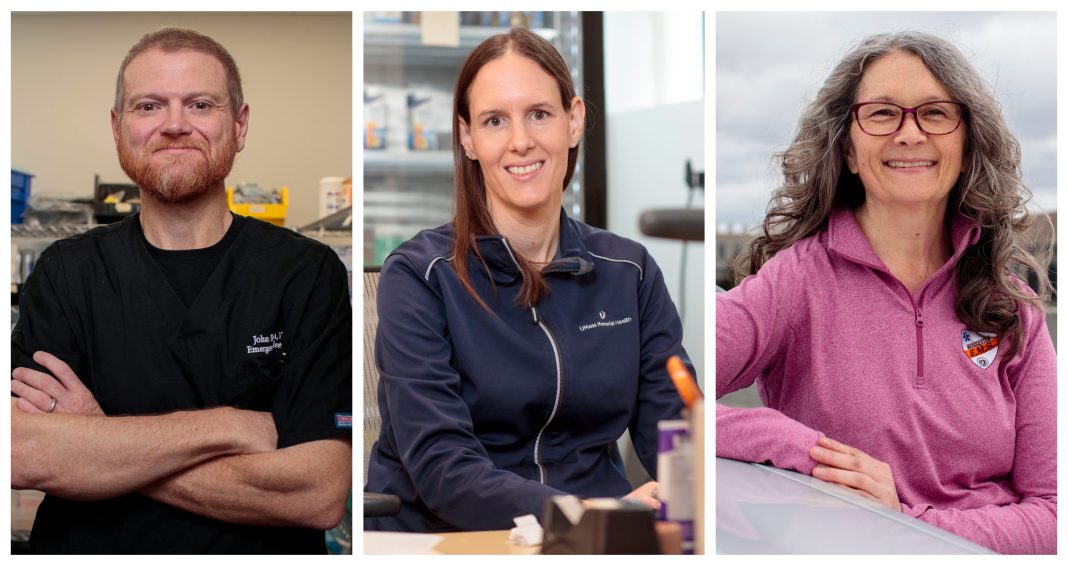
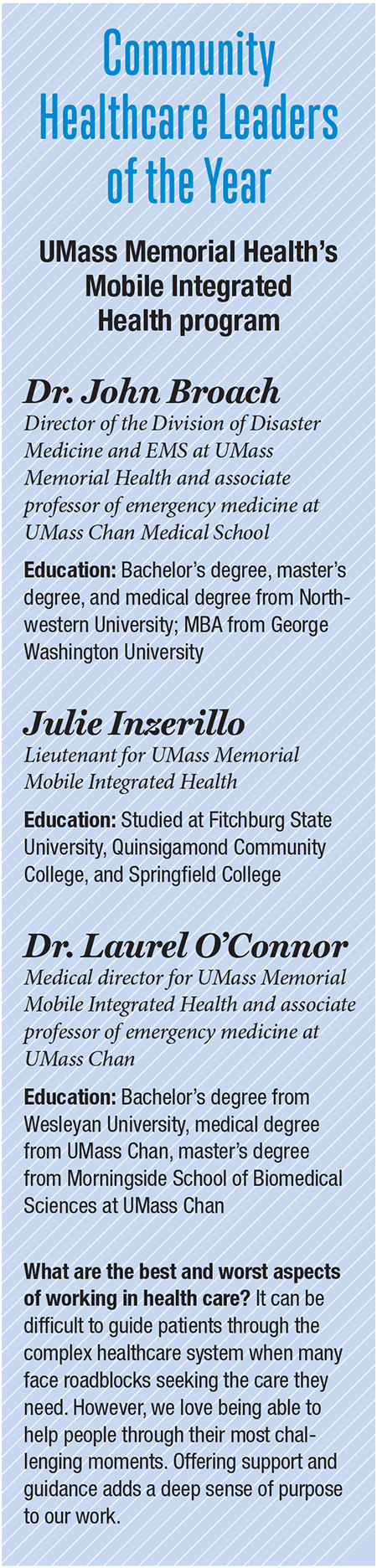
“We’re not instead of, we’re complementary to,” said Dr. Laurel O’Connor, an emergency medicine specialist who helped spearhead the MIH initiative at UMass Memorial.
On-site, paramedics can perform basic diagnostics or even administer medicine like antibiotics, breathing therapies, or IV fluids.
These paramedics are able to remotely consult with emergency department physicians and drive the patient to the hospital if an emergency is taking place.
The program was in large part O’Connor’s brainchild and has expanded to include about 20 UMass Memorial-based practices since its launch in 2021.
When not teaching or caring for patients, O’Connor identifies primarily as a researcher specializing in health care provided in settings other than hospitals, such as major public sporting events or during disasters. A passionate expert in the field, she jokingly referred to badgering UMass Memorial leadership into piloting an MIH initiative.
But MIH, which primarily services elderly patients, is more than just O’Connor.
There are about 15 people working in the program, including on-hand physicians in the emergency room and a fleet of paramedics based out of Worcester EMS, which UMass Memorial runs. The individual practices signed onto the program include primary care providers as well as specialists.
“The major benefit we see is just how much patients love this program,” said Julie Inzerillo, a paramedic who developed MIH’s initial protocols along with O’Connor. Some patients, the pair recalled with a laugh, loved the program so much they have begun to request specific paramedics.
Those kinds of interpersonal connections can feel lacking for patients as they navigate a congested healthcare system still recovering from the coronavirus pandemic. But with MIH, paramedics meet patients in their home, which has the dual impact of keeping a potentially vulnerable patient out of the hospital while allowing providers to informally assess their living conditions.
Those living conditions can sometimes provide important clues about a patient’s health or risk factors, said Dr. John Broach, director of the Division of Disaster Medicine and EMS at UMass Memorial Health. He provides administrative oversight to the program while O’Connor oversees most day-to-day operations.
“You’re seeing them as a person in their environment, not just as a patient,” Broach said.
When talking about the MIH program, Broach, Inzerillo, and O’Connor all refer repeatedly back to patient experience, one-on-one care, and argue for integrating MIH into healthcare systems more broadly, which likely won’t happen until insurers agree to cover MIH services. Proposed legislation on Beacon Hill would require insurers to do so.
Once integrated, healthcare systems stand to actually save money on care, O’Connor said. While conceding it’s a moving target, her research has found MIH visits cost less than emergency room visits, and certainly less than hospitalizations.
“This should be the future of medicine,” said Dr. Eric Dickson, president and CEO of UMass Memorial Health.
The UMass MIH program resulted in 40% fewer ER visits and 60% fewer admissions for patients who received MIH care, Dickson said.
Programs like MIH help address the mega trend in health care of aging populations needing more care and aging caregivers, who will need the next generation to step in.
But as with any sort of new paradigm, MIH requires champions like O’Connor, Broach, and Inzerillo to demonstrate to policymakers, providers, and even patients, why these novel approaches are worth backing. They don’t fall out of thin air; they’re the result of hard work and passionate medical workers.
“It only works if you have the Julies of the world,” Dickson said.

