🔒Sticking with sustainability: Despite business and political pressure, Worcester’s specialized stretch codes for buildings are here to stay
Developer WinnCompanies and construction firm F.W. Madigan are building the Residences on Lincoln Square to passive house standards. PHOTO | COURTESY OF F.W. MADIGAN
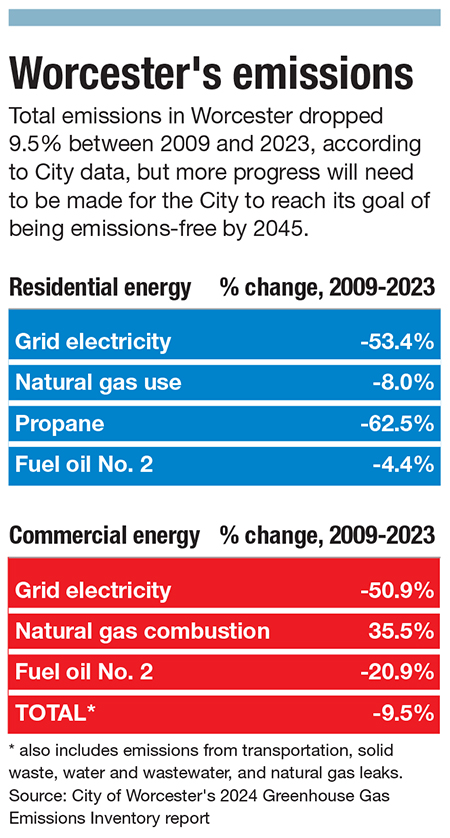
In September 2023, the Worcester City Council voted 10-1 to adopt specialized stretch codes, part of its mission to create the greenest midsized city in the country. The most stringent of the three levels of building energy codes in Massachusetts, specialized stretch codes seek to advance buildings toward having net-zero emissions, with requirements like pre-wiring […]
In September 2023, the Worcester City Council voted 10-1 to adopt specialized stretch codes, part of its mission to create the greenest midsized city in the country.
The most stringent of the three levels of building energy codes in Massachusetts, specialized stretch codes seek to advance buildings toward having net-zero emissions, with requirements like pre-wiring buildings for electrification and requiring solar installations on available roofs and parking areas.
Tackling building-related emissions will be critical toward the City of Worcester’s goal of reaching net-zero emissions by 2045, as operations of buildings account for 30% of global final energy consumption and 26% of global energy-related emissions, according to the International Energy Agency.
Since specialized stretch codes were developed in 2021 by the Massachusetts Department of Energy Resources, 54 other municipalities, accounting for about 31.5% of the state’s population, joined Worcester in adopting the codes.
The change in codes has not been without its critics. Some local real estate executives have relayed stories of the codes are scaring away developers who would otherwise be interested in building in Worcester. During the city council debate, Jon Weaver, president and CEO of Massachusetts Biomedical Initiatives, expressed support for the overall premise of building green, but warned certain aspects of the code may hinder biotech growth in the city.
The political and economic climate has shifted significantly since the codes were implemented. Construction and labor costs have increased since the COVID-19 pandemic, and the President Donald Trump Administration’s attitude toward sustainability and climate change has cast a shadow over green economy.
John Odell, City of Worcester chief sustainability officer
Despite changing federal attitudes and some grumbling from the development world, Worcester’s stretch codes are here to stay, said John Odell, chief sustainability officer for the City.
“The state certainly has not backed down, which is great,” Odell said. “Here in the city, we're boarding the same boat. We're not backing down either. This is actually a good thing for economic reasons as well as environmental reasons. So onward we go.”
The new standard
Odell has been taken aback by the Trump Administration's attitude toward sustainability, but it hasn’t undermined the City’s commitment to specialized stretch codes and environmental efforts.
“I must say the challenge was pretty daunting before the new administration,” he said. “Under the current administration, I don’t think most people thought there would be such a pullback.”
James Moriarty, co-founder of Sustainable Comfort
The shift in federal approach has created some uncertainty, but the sustainable construction space hasn’t been hit as hard as industries like solar or offshore wind, said James Moriarty, chief product officer and co-founder of Sustainable Comfort, a Worcester-based consulting, construction, development, and property management firm.
“Massachusetts can pass its own codes, and a lot of the incentives the states are still there,” Moriarty said. “The Affordable Housing Tax Credits are still coming from the federal sources. It’s more of a lost opportunity than it is a hold back.”
Despite the noise, Odell has stayed consistent with his arguments in favor of the code, saying they create a higher standard of building. While costs are a top-of-mind for developers, Odell says once builders get one project under the new codes completed, that experience can actually lead to future savings.
“It’s probable the first project that they build may cost anywhere from 1% to 3% more for developers,” Odell said, “but by the second and all subsequent development under the code for those developers, the total cost will actually be less than what would have been using the standard code.”
Having an all-electric set-up is one factor in lowering costs, Odell said, eliminating the need to build out separate fossil fuel infrastructure. Yet, experience building under the stretch code is a big driver in eventual savings.
“Mistakes cost money, and the fewer mistakes you make, the less money you'll spend fixing them,” he said. “So that's a big piece of it.”
Worcester is hardly an outlier in its movement toward more green buildings. While the topic is often framed from an environmental viewpoint, this new wave of construction and design is really about more than that, said Ken Neuhauser, president of Worcester-based Building Evolution Corp.
Neuhauser’s firm views energy efficiency as the end result of constructing a high-quality building.
“We developed an understanding that the energy efficiency is the tail of the dog,” he said. “It's the thing that we get when we get the building right.”
Neuhauser said there aren't enough data points for Worcester to measure the impact of specialized stretch codes, but he said higher sustainability standards is the direction the majority of the development world are heading toward.
“We recognize that some development has an internal business imperative to be high performance anyway,” he said. “Affordable housing and institutional developers have already been doing passive buildings, or very close to it. So there's not much of a lift for those kinds of developers, but for the kind of development activity that does not have the internal business imperative for high performance, it's more of a struggle.”
Market-rate housing development has been the slowest to adapt, particularly with developers looking to build and then flip properties, Neuhauser said.
“The market demands maximizing profit, which is minimizing costs,” he said. “It's often turnkey time development, so it's not held, whereas affordable housing institutions are going to build and hold so they have a vested interest in the long-term performance, liability, operability, and resilience of the property.”
Beyond the environment
While it was permitted before Worcester’s specialized stretch code went into effect, Boston-based WinnCompanies already had sustainability at the top of mind when it embarked on the Residences on Lincoln Square, a $51-million project to convert the former Lincoln Square Boys Club into 80 affordable apartments for seniors.
While it wasn’t possible in the existing brick building on the site, the new building is being built to passive house standards, which make up part of the specialized stretch codes.
Christina McPike, VP of energy & sustainability at WinnCompanies
“Often you might start with a passive house design and have to do what we call value engineering, which is cutting costs out of projects,” said Christina McPike, vice president of energy & sustainability at WinnCompanies. “Sometimes you see passive house projects become value engineered into a lower-cost, but still good, building. We were able to make the numbers work on this one and commit to passive house for this project.”
The benefits of living in a building built to passive housing requirements go beyond the environment, McPike said. More insulation and higher building standards lead to a quieter and more peaceful living space, an aspect which is particularly valuable for a project like Lincoln Square, which is near a busy intersection, a highway, and a freight train line.
Another oft-overlooked benefit is an improvement of building air quality. While the topic of air quality was near the top of the public’s mind during the pandemic, it has remained a focus of public health experts.
There’s an emerging wave of evidence that pollution created by heating and cooking can have negative impacts on health, with the World Health Organization saying indoor air pollution is linked to an estimated 3.2 million premature deaths annually worldwide.
“There's all kinds of other stuff that happens when you burn fuel, gas, or oil, and none of them are good to breathe in,” Odell said. “Over time, those cumulative effects can have real health impacts, especially for younger kids or older folks.”
Compliance without cost
Part of what Moriarty does at Sustainable Comfort is help developers meet their sustainability goals. While new construction gets a lot of attention, his advice to developers is to remember the positive impact that weatherization and technology like heat pumps can have on existing buildings. Preparation and education are key, he said.
“It's really hard to apply a passive house design, if you find out about it right before you submit for a permit,” he said.
Neuhauser said much of the complaints about the codes can be labeled as excuses, saying building both better and cheaper is possible with experience.
“When we first got involved with projects that were doing passive building certification, we were seeing some incremental cost, maybe on the order of 3%, but it certainly wasn't huge,” he said. “After a few iterations, the costs can go negative. There are plenty of things we can do to improve performance and also reduce the cost of building.”
Odell’s advice is for developers to coordinate with utility companies from the beginning to ensure a site will have the needed capacity, and to reach out to the City’s Inspectional Services Department for guidance before starting.
“The devil's in the details, because every project is different,” he said. “The risk is that if you sort of just do what you've always done and don't plan for exactly which path you want to go down, you may find yourself partway down the path and realize you have to switch, which can add delays and cost.”
Eric Casey is the managing editor at Worcester Business Journal, who primarily covers the manufacturing and real estate industries.


 “Mistakes cost money, and the fewer mistakes you make, the less money you'll spend fixing them,” he said. “So that's a big piece of it.”
Worcester is hardly an outlier in its movement toward more green buildings. While the topic is often framed from an environmental viewpoint, this new wave of construction and design is really about more than that, said Ken Neuhauser, president of Worcester-based Building Evolution Corp.
Neuhauser’s firm views energy efficiency as the end result of constructing a high-quality building.
“We developed an understanding that the energy efficiency is the tail of the dog,” he said. “It's the thing that we get when we get the building right.”
Neuhauser said there aren't enough data points for Worcester to measure the impact of specialized stretch codes, but he said higher sustainability standards is the direction the majority of the development world are heading toward.
“We recognize that some development has an internal business imperative to be high performance anyway,” he said. “Affordable housing and institutional developers have already been doing passive buildings, or very close to it. So there's not much of a lift for those kinds of developers, but for the kind of development activity that does not have the internal business imperative for high performance, it's more of a struggle.”
Market-rate housing development has been the slowest to adapt, particularly with developers looking to build and then flip properties, Neuhauser said.
“The market demands maximizing profit, which is minimizing costs,” he said. “It's often turnkey time development, so it's not held, whereas affordable housing institutions are going to build and hold so they have a vested interest in the long-term performance, liability, operability, and resilience of the property.”
“Mistakes cost money, and the fewer mistakes you make, the less money you'll spend fixing them,” he said. “So that's a big piece of it.”
Worcester is hardly an outlier in its movement toward more green buildings. While the topic is often framed from an environmental viewpoint, this new wave of construction and design is really about more than that, said Ken Neuhauser, president of Worcester-based Building Evolution Corp.
Neuhauser’s firm views energy efficiency as the end result of constructing a high-quality building.
“We developed an understanding that the energy efficiency is the tail of the dog,” he said. “It's the thing that we get when we get the building right.”
Neuhauser said there aren't enough data points for Worcester to measure the impact of specialized stretch codes, but he said higher sustainability standards is the direction the majority of the development world are heading toward.
“We recognize that some development has an internal business imperative to be high performance anyway,” he said. “Affordable housing and institutional developers have already been doing passive buildings, or very close to it. So there's not much of a lift for those kinds of developers, but for the kind of development activity that does not have the internal business imperative for high performance, it's more of a struggle.”
Market-rate housing development has been the slowest to adapt, particularly with developers looking to build and then flip properties, Neuhauser said.
“The market demands maximizing profit, which is minimizing costs,” he said. “It's often turnkey time development, so it's not held, whereas affordable housing institutions are going to build and hold so they have a vested interest in the long-term performance, liability, operability, and resilience of the property.”