Two of Central Massachusetts’ highest-paid CEOs run companies where median employees likely qualify for SNAP benefits.
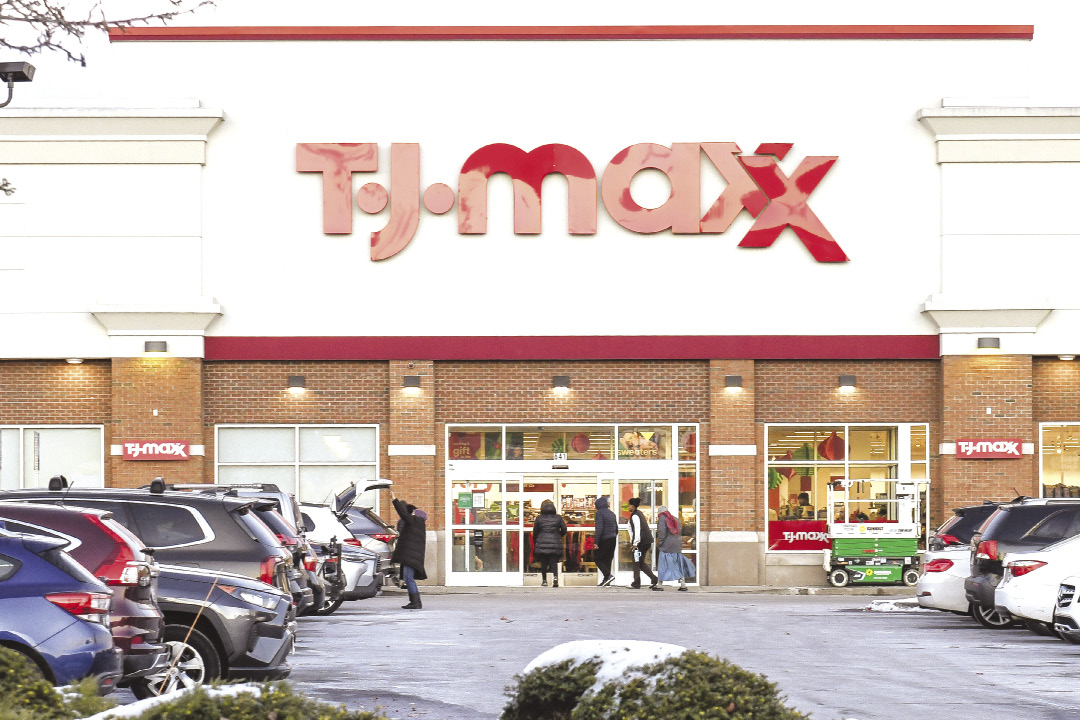
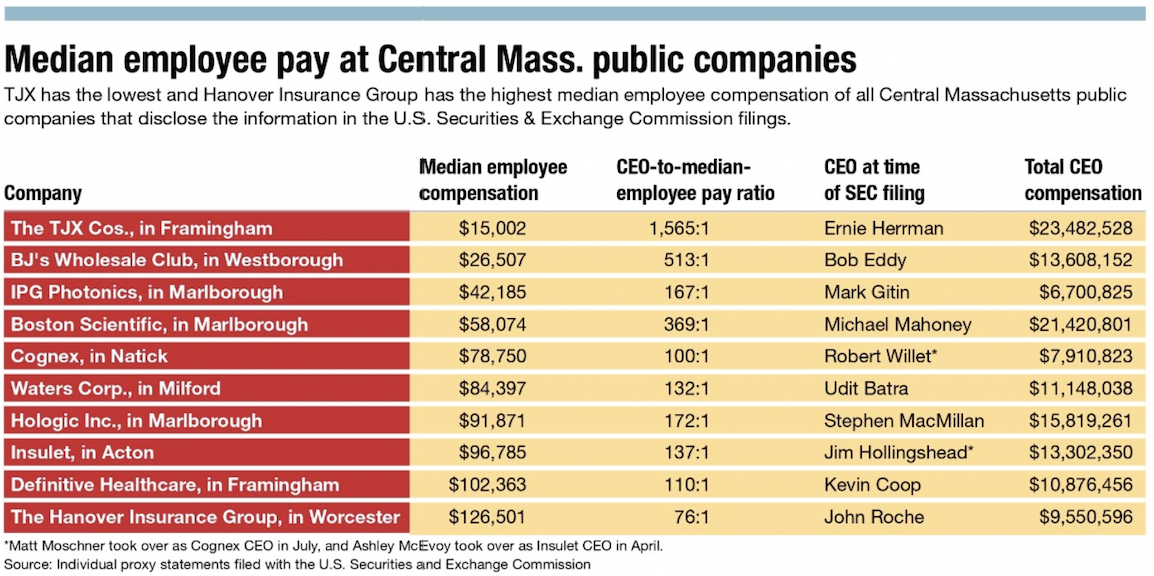
As the region’s top-earning public company CEO, Ernie Herrman, president and CEO of TJX Cos. in Framingham, brought home $23.48 million in total compensation for fiscal 2024. That is a figure 1,565 times that of the company’s median employee compensation, which sat at $15,002.
The TJX median employee compensation is $58 below the federal poverty level. TJX is the parent company for brands like TJ Maxx, HomeGoods, and Marshalls.
Bob Eddy, chairman, president, and CEO of Marlborough-based BJ’s Wholesale Club earned $13.61 million in total compensation in fiscal 2024. As fourth on the highest-paid public company CEO list in the region, Eddy earned 513 times that of his median employee compensation, which is $26,507.
At those pay rates, the median TJX and BJ’s employees would have brought home about $1,250 and $2,209 per month, respectively, both well below the $2,608 maximum monthly income limit for Supplemental Nutrition Assistance Program (SNAP) eligibility for a household of one, according to the Massachusetts Department of Transitional Assistance.
These low wages are by design to keep employees on part-time hours, which reduces the cost of benefits and discourages unionization. Companies, including TJX and BJs, end up employing hundreds of people on government food assistance, turning public disputes over the social safety net – such as President Donald Trump’s suspension of SNAP during the federal government shutdown this fall – into business issues.
“Big corporations and the big employers are the true welfare queens,” said Mariana Chilton, professor of practice at the UMass Amherst School of Public Health and Health Sciences.
BJ’s did not return WBJ’s request for comment regarding its median employee compensation. TJX did not comment directly, instead sending a statement that the company offers a range of supportive services and programs for its employees.
“At TJX, we know our associates bring our business to life, and we aim to support them by making TJX a terrific place to work, providing many career development opportunities, and maintaining our strong culture,” TJX wrote in its statement. “Fostering a positive work environment to help our associates feel welcome, valued, and engaged is core to how we operate, and we believe this encourages many associates to join us not just to find a job, but to build a career.”
Median employee pay chart
Part-time work, by design
Median compensation for TJX and BJ’s employees is lower because the companies are heavily reliant on part-time workers, according to their individual proxy statements filed in June with the U.S. Securities & Exchange Commission.
This reliance on part-time work is intentional, said Chilton.
Mariana Chilton, professor of practice at UMass Amherst
“Employers purposely hire people at less than full-time, which then allows them to not have to pay health care,” Chilton said. “There's a disincentive in the system.”
Half of all Massachusetts workers who receive SNAP benefits work part-time, according to UMass Amherst’s “SNAP Workers: Working People & SNAP Benefits in Massachusetts” report, released in December.
Many part-time workers receiving SNAP are actively trying to find full-time work, but many big-box companies won’t offer it, said Chilton.
“They want to keep people in very precarious positions so they can kind of control who does what, and it saves them a lot of money and makes their profits increase. It's a big problem,” she said.
As of Dec. 5, the majority of both companies’ open back-office and corporate roles were full-time: 94% for TJX and 96% for BJ’s. At the same time, 73% of TJX’s open retail, distribution center, and store operation positions are part-time, and 55% of BJ’s club operation roles are part-time.
Because of these systemic rates of part-time work, the retail industry, along with health care, have the highest number of SNAP recipients in Massachusetts: approximately 68,000 each, totalling 29% of all working SNAP recipients, according to the UMass Amherst report. Cashiers are hit the hardest, with one out of every five relying on SNAP benefits.
This is partially because many of those industries’ entry-level positions don’t require a high-level of education or certifications, said Nathan Meyers, a fellow at the UMass Labor Center and co-author of the report.
TJX addressed this in its 2024 annual report, saying failure to employ and retain enough qualified associates could adversely affect the company’s performance:
“We must constantly recruit new associates to fill entry level and part-time positions, which have high rates of turnover,” said the TJX annual report.
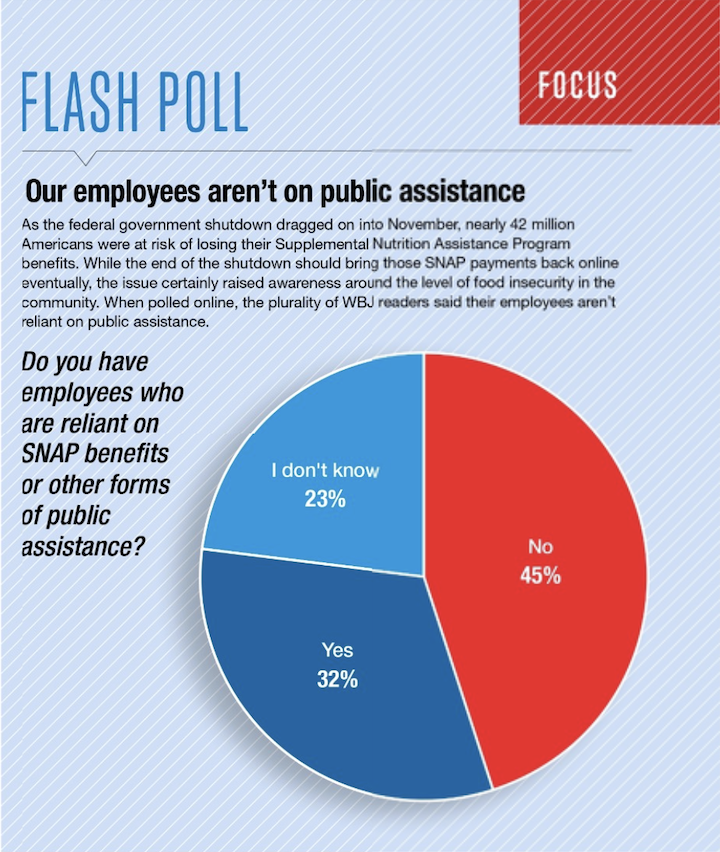
Pubic assistance flash poll
Anti-union structure
One of the most important facts to understand why retail wages are so low is because of the absence of one key factor, Meyers said.
“Unions have never had a really strong foothold in retail,” he said.
Nathan Meyers, co-author of UMass Amherst's SNAP report
TJX and BJ’s have established clear anti-union sentiments in their annual reports.
“None of our team members are represented by a union. We consider our relations with our team members to be good,” reads BJ’s 2024 annual report. “Future union activities, including organizing efforts, slow-downs, or work stoppages could negatively impact our business and results of operations.”
TJX specifically outlines what it views as possible ramifications of unions in its annual report’s operational and strategic risks section. The company has a number of U.S. and Canadian distribution centers with unionized associates; TJX states these could lead to several negative consequences, such as work stoppages and decreased flexibility due to labor law limitations.
TJX further reports if other portions of its workforce unionize, such as its U.S. associates, the act “may subject us to additional requirements, expectations, actions, or expense.”
TJX and BJ’s are not alone in their anti-union stances, as public and private companies with low-wage workers often share the sentiment, said Chilton.
“Unions automatically bring people together and build a level of solidarity where they can fight for higher wages and better supports,” she said. “The number one thing that unions do is promote higher salaries that are living wage salaries.”
A heavy reliance on part-time work is a way to deter unions, Chilton said, as the less time coworkers spend with each other, the less likely they are to feel connected and empowered to organize.
These companies can get away with their low-wage, part-time work because they’re able to rely on the government to provide public assistance.
“Increased profits come from lower compensation, and it means that the government is pressured to prevent poverty and hunger,” said Meyers. “The government is subsidizing corporate profits in that way.”
To take it a step further, many large private corporations rely on SNAP benefits to pay their own bills: BJ’s annual report said the federal government’s potential cut to SNAP could in turn hurt the company’s sales.
“Changes in state and federal laws governing the SNAP program, including reductions in program benefits, restrictions on program eligibility, or rules on where and for what EBT cards may be used, could reduce sales at our clubs,” said its annual report.
Large companies operating in Massachusetts are reliant on SNAP to provide additional assistance to hundreds, if not thousands, of their employees, according to the UMAss Amherst report. The employer with the most SNAP recipients in 2020 was Dunkin, with 1,195 employees.
Amazon and Walmart both employ more than 2,000 Massachusetts residents who received SNAP benefits in 2025, according to a Boston Globe analysis of Massachusetts Department of Transitional Assistance data.
TJX employs 589 Massachusetts residents who received SNAP this year, according to the Globe. The company employs at least 1,000 people in Central Massachusetts and 364,000 worldwide, according to the Massachusetts Executive Office of Labor and Workforce Development and TJX’s annual report.
BJ’s has 347 employees in Massachusetts on SNAP, according to the Globe. The company no longer discloses its employee counts, but its last response to the WBJ Research Department in 2021 said BJ’s had 2,000 employees in Central Massachusetts and 4,800 statewide. The company employs 33,000 part-time and full-time employees worldwide, according to its 2024 annual report.
The Central Massachusetts employer with the highest number of SNAP recipients in the state is Worcester hospital UMass Memorial Medical Center’s medical staff services, at 660, according to the Globe.
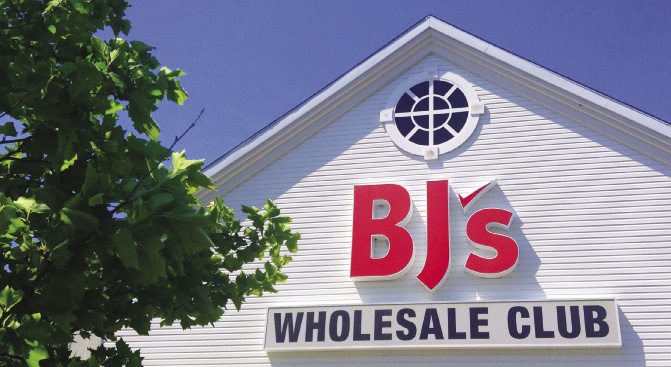
None of BJ's employees are unionized, as the wholesale retailer sees unions as possible threats to its business operations. PHOTO WBJ FILE
Relying on women, people of color
Worcester County has an 11% SNAP recipiency rate, falling in the middle of the state where recipiency rates peak in Hampden County with 19.0% and trough with Middlesex County at 6.7%, according to the UMass Amherst report.
Across the state, women disproportionately rely on SNAP, as 12% of working women are beneficiaries as opposed to 9.5% of working men.
Women are more likely to be in single-parent households than men, said Meyers. Single mothers represent 80% of single-parent family groups, as reported by the U.S. Census Bureau.
“With gender roles in our society, it's likely for women to leave the workforce at higher rates than for men, which could upset their career trajectory or pause their career trajectory,” said Meyers.
Additionally, the vast majority of low-wage, part-time workers are women, and specifically women of color, said Chilton.
The National Women's Law Center reports 45.2% of Black women and 41.6% of Latinas working part-time have incomes below 200% of the federal poverty level, as opposed to 20.1% of white women.
At TJX, 77% of its global workforce is made up of women and 60% of its U.S. workforce is people of color, according to the company’s Inclusion & Diversity webpage.
Additionally, women are more likely to serve in jobs requiring them to show up in person, according to the NWLC. Women make up most of the country’s care economy, said Chilton.
“They tend to be the greeters. The ones who are the friendly ones, the ones that provide care to the public,” she said.
Mica Kanner-Mascolo is a staff writer at Worcester Business Journal, who primarily covers the healthcare and diversity, equity, and inclusion industries.