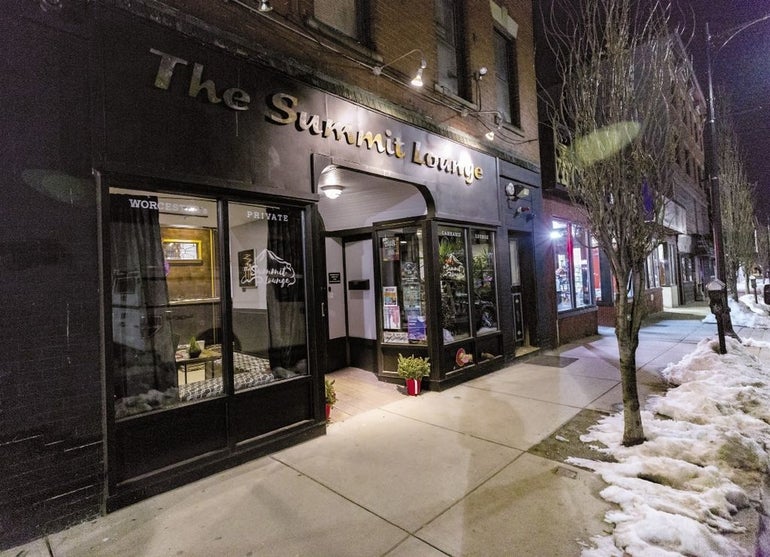
The Summit Lounge, a private cannabis consumption club in Worcester’s Canal District, will close after eight years as owner Kyle Moon seeks a larger location and a state-licensed business model.
The lounge announced a farewell event for Saturday, Nov. 7, beginning at 5 p.m. and running until 11 p.m.
“Summit will return some day, in a different fashion,” the announcement reads.
Moon told WBJ rising costs and the limitations of the Water Street space drove the decision. The location doesn’t have enough space to accommodate his plans for cannabis consumption and food. The venue was the state’s first known private cannabis consumption lounge when it opened in 2018.
“As the costs have risen, that space has become more and more financially unstable,” Moon said.
Moon is evaluating several potential spaces and intends to remain in Worcester.
“We’re definitely staying in Worcester,” he said. “You know, I’m really passionate about that.”
Rather than simply reopening the membership club elsewhere, Moon wants to pursue state licensing for a social consumption business.
He said the timing depends on grant availability, Worcester opting into social consumption, and state applications and guidance. No new location or reopening timetable has been finalized.
Summit opened in 2018, allowing members to bring and consume their own cannabis. Summit obtained city licenses to operate as a private club, including a smoking permit, but drew controversy when then-City Manager Ed Augustus Jr. alleged its operators had not disclosed plans to allow members to consume marijuana.
By March 2019, WBJ reported membership hovered around 300. The club did not sell THC-containing cannabis and operated outside the Cannabis Control Commission’s licensing framework as a private club.
The lounge became a gathering place for cannabis entrepreneurs, industry employees and consumers.
Moon said the original club fulfilled its purpose as a community space, but its size and operating structure no longer fit his goals. He remains hopeful about creating a licensed consumption venue, while acknowledging uncertainty surrounding the state’s ongoing implementation of such sites.
Nearly a decade after voters authorized cannabis consumption sites through the 2016 legalization initiative, state regulations took effect in January, and the Cannabis Control Commission expects to begin accepting applications soon for supplemental licenses, allowing on-site consumption at existing marijuana businesses.
The closure comes as Massachusetts voters prepare to decide Question 8 on Nov. 3, a ballot initiative that would end legal recreational marijuana sales, while preserving limited adult possession and the medical marijuana program.
Eric Casey is the managing editor at Worcester Business Journal, and primarily covers the real estate and banking & finance industries.
