Already a Subscriber? Log in
Get Instant Access to This Article
Subscribe to Worcester Business Journal and get immediate access to all of our subscriber-only content and much more.
- Critical Central Massachusetts business news updated daily.
- Immediate access to all subscriber-only content on our website.
- Bi-weekly print or digital editions of our award-winning publication.
- Special bonus issues like the WBJ Book of Lists.
- Exclusive ticket prize draws for our in-person events.
Click here to purchase a paywall bypass link for this article
A contractor has accused The Menkiti Group, a development firm that owns several downtown properties, of concealing a report that revealed safety concerns about the crumbling stone facade of its project at 204 Main St. and withholding roughly $1 million in payments.
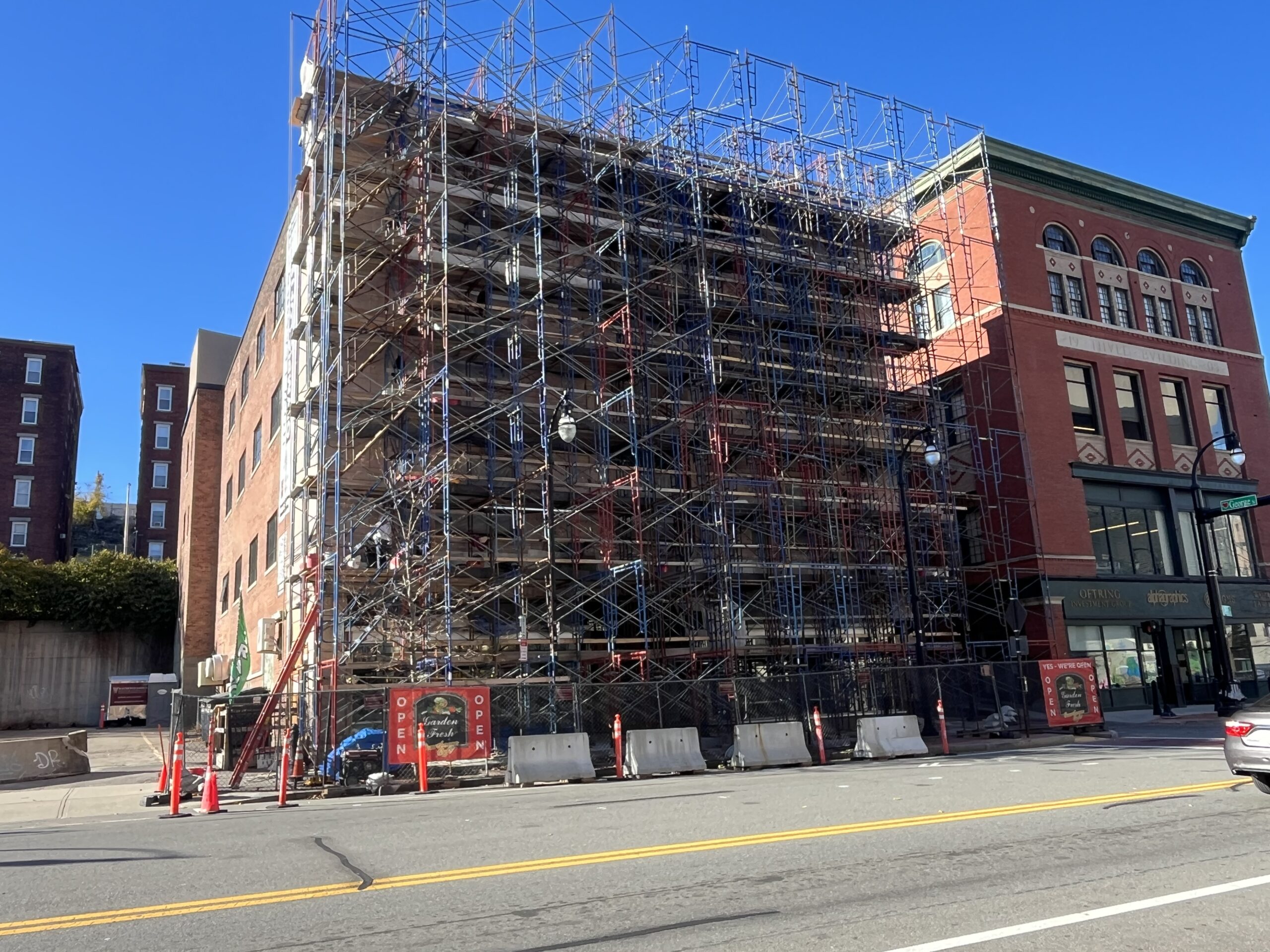
In a complaint filed in Worcester Superior Court on Oct. 20, Seekonk-based contracting firm D.F. Pray alleges The Menkiti Group, based in Washington, D.C., withheld information about the allegedly unsafe, cracked and deteriorating facade at the old Kane Building at 204 Main St. that Menkiti was developing into 20 apartments. The rest of the project is finished, the complaint said, except the east façade. Menkiti is already leasing the apartments.
The complaint alleges that, unbeknownst to Pray, the developer discovered “latent and unforeseen issues with the building envelope design” and retained consulting architect Gorman, Richardson, Lewis Architects to review the project.
At Menkiti’s request, the firm then drafted a 22-page safety review of the project in April 2025 that warned of dangerously cracked, deteriorating stones on the building's facade. Pray alleges the developer concealed the safety hazard while pushing them to continue work without a structural redesign.
According to the complaint, GRLA’s report confirmed “several masonry areas where brick appears ready to spall. This current condition of the exterior masonry represents a fall hazard/life safety concern, and an up-close assessment with an aerial lift to remove elements about to break away should be performed as soon as possible.
“Significant spalling, deterioration, and cracks were observed in the concrete during our site visit. This current condition of the exterior pre-cast concrete veneer represents a fall hazard/life safety concern and an up-close assessment with an aerial lift to remove elements about to spall should be performed as soon as possible,” the complaint said.
After completing its investigation, GRLA confirmed the condition was “unforeseeable,” required further investigation by the design team, and recommended that “[o]verhead protection should be installed over the sidewalk as soon as possible.”
On Nov. 6 and Nov. 14, 2025, the architect, with the assistance of a structural engineer, continued the investigation, the court filings state, directing Pray to remove two 400-pound precast pieces held to the building with a thin, approximately 9-gauge wire, but for more than 14 days, Pray's work remained suspended on the east façade without being given a time extension.
The complaint alleges that the developer's representative, Mark Rengel, Menkiti Group’s vice president of development, hid the report and "knowingly, intentionally and falsely" blamed Pray for a 118-day project delay, resulting in Menkiti hitting Pray with $140,500 in ongoing fees and withholding $804,750 in payments.
Monday afternoon, a restoration company was working on the facade of the building at 204 Main St.
Menkiti responds
In a statement to the WBJ Monday, The Menkiti Group says the allegations in the suit are false and that safety is of the utmost importance: “We take issue with the claims in the complaint filed by D.F. Pray last week and we will use the legal process to address them specifically. Our focus remains on meeting requirements and moving projects forward — not engaging in public disputes.
“Safety and respect for the people who build our projects are of upmost importance to The Menkiti Group and core to how we operate. D.F. Pray’s allegations concerning our approach to job safety on the 204 Main Street project are false. Its recent lawsuit also includes a request for payment for work that was never performed, let alone approved by The Menkiti Group.
“Above all, Menkiti Group values its relationships with our contractors and partners. Currently, there are six tenants already residing in the Kane Building at 204 Main Street, as well as the Garden Fresh Courthouse Café. We received a temporary certificate of occupancy for 14 of the apartments on July 31, 2026.
“The Menkiti Group has been a responsible developer, working in partnership with City of Worcester and community stakeholders. We are a long-term investor in Worcester. We have been investing in downtown revitalization projects since 2018. With $50 million in value created to date, and another $120 million in the pipeline, we have been a leader in transforming vacant property on Main Street. We have remained committed to Worcester even through the economic challenges of covid and historic inflation levels."
The Menkiti Group said the company has been investing in downtown revitalization projects since 2018. The company said it created $50 million in value to date with another $120 million in the pipeline, and has been a leader in transforming vacant property on Main Street.
“Our goal is to support Worcester’s growth by preserving heritage and introducing new energy into the fabric of Downtown Worcester in a way that is sustainable, inclusive, and aligned with the city’s long-term vision. We remain committed to transparency, collaboration, and delivering projects that benefit Worcester residents and businesses,” Menkiti said.
D.F. Pray did not respond to a request for comment Monday.
‘A known life-safety hazard’
The complaint further alleges that Rengel tried to hide “a known life-safety hazard, blame the contractor for it and then use the resulting delay as a pretext to seize nearly $1 million of the contractor's earned money.”
Pray’s complaint says that correspondence from Menkiti classified $165,000 worth of necessary facade work as “new scope,” legally weakening the developer's claims that the facade work fell under Pray's original contract obligations.
In Pray’s filing, it requests that the court “forcefully enforce” the lien for the nearly $1.1 million it asserts it is owed in unpaid balances and damages. If the court rules in Pray’s favor and the judgment goes unpaid, Pray requests that the building be sold at auction to satisfy the debt, according to the filing.
Menkiti Group is also in charge of several apartment development projects in downtown Worcester, including the estimated $27 million residential conversion at 401-409 Main St. into 48 market-rate apartments; and the construction of at least 175 units at the soon-to-be-demolished Denholm building at 484 Main St.
Legal conflict at 204 Main St.
The legal conflict stems from a breakdown in the project's timeline, with both parties blaming each other for structural delays.
Menkiti hired Pray as construction manager to complete the $7.7 million conversion of the historic office building at 204 Main St. into 20 residential units marketed as “Olympic Lofts.”
In April to November 2025, Pray requested to suspend facade work until a structural redesign was provided after an architectural safety review warned of crumbling stone. However, Pray claims Rengel refused to issue a redesign or extend the completion deadline.
In January 2026, The Menkiti Group temporarily halted the facade work. Believing the site lacked sufficient overhead sidewalk protection, Pray went to a judge to request a formal, court-ordered work suspension, which the judge ultimately denied. Pray then finished construction on the 20 new apartments by June 2026, leaving the contested facade unfinished. By August, sidewalk protections were removed and the developer began leasing out the units.
But months before Pray encountered it, the owner and Rengel received a report warning that the east façade presented a "safety concern" requiring immediate investigation, the complaint says.
It further alleges that Rengel “elected to only share limited, discrete and selected portions of the report” only sharing portions of it with Pray and “buried the remainder (with the associated details of the life safety issues and the recommended remediations) and did nothing for six months, while Pray's workers, the public, and patrons to the restaurant (located on the first floor of the Property) walked beneath approximately 400-pound precast panels held to the building by existing wood strapping and a single nine-gauge wire connection.”
The complaint further alleges that Rengel then signed a series of "good faith" certifications he “knew to be false: rejecting change orders that the contract required him to pay, rejecting notices of Substantial Completion (even after a temporary certificate of occupancy was issued), and assessing liquidated damages retroactively in violation of the contract's express notice requirement.”
