Already a Subscriber? Log in
Get Instant Access to This Article
Subscribe to Worcester Business Journal and get immediate access to all of our subscriber-only content and much more.
- Critical Central Massachusetts business news updated daily.
- Immediate access to all subscriber-only content on our website.
- Bi-weekly print or digital editions of our award-winning publication.
- Special bonus issues like the WBJ Book of Lists.
- Exclusive ticket prize draws for our in-person events.
Click here to purchase a paywall bypass link for this article
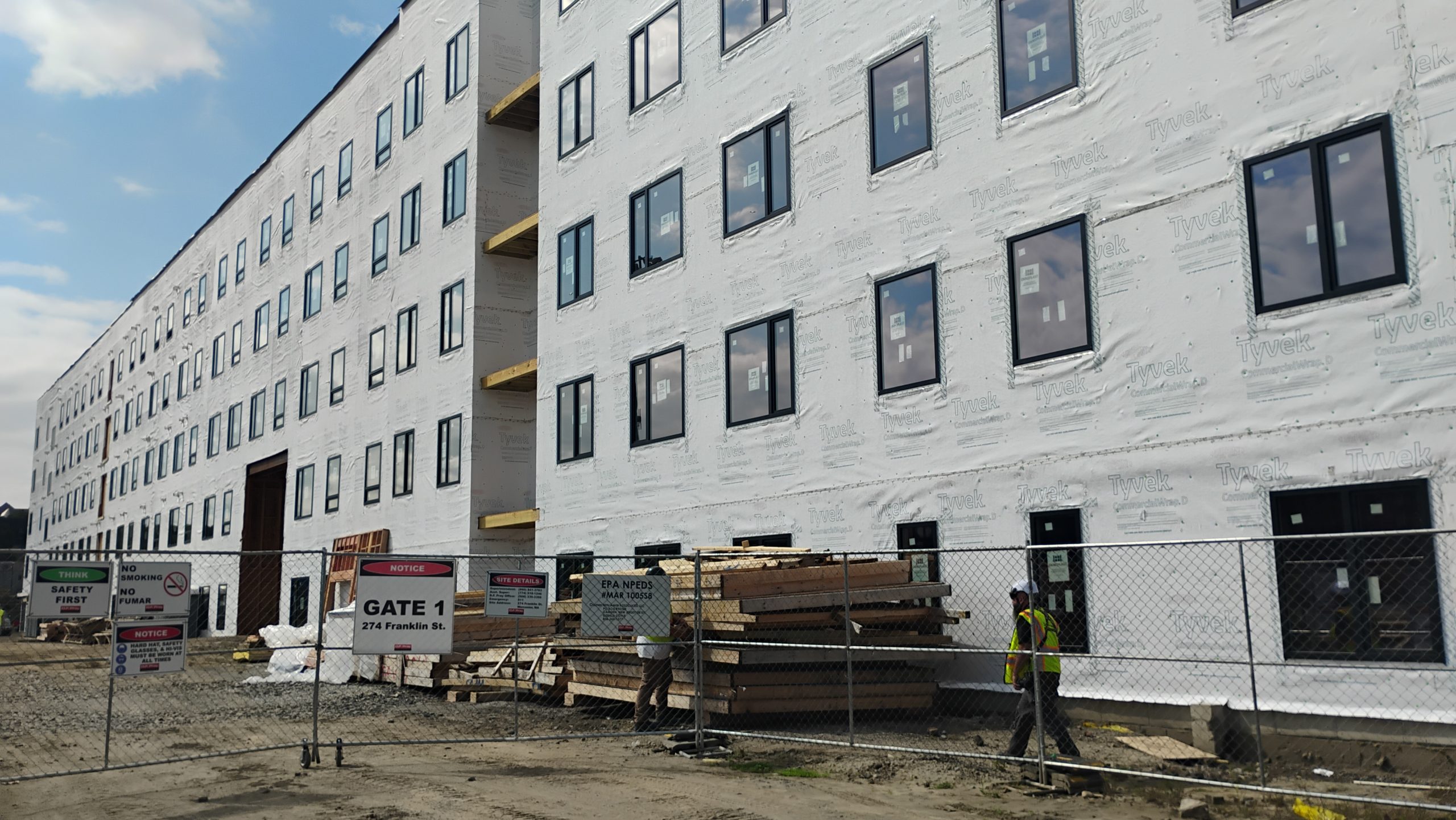
A New Hampshire company that had been doing drywall work at an apartment building under construction on Franklin Street was denied by a Suffolk County Superior Court judge in its bid to block its removal from the project.
The drywall firm Optiline Enterprises filed suit Friday against the City of Worcester, Benjamin on Franklin apartment project owner Benjamin Associates LLC, and Seekonk-based general contractor D.F. Pray Inc. after the city said the company could not work on tax-subsidized Worcester developments because of an alleged 2024 violation.
The complaint sought a declaration that the city improperly applied its Responsible Development Ordinance, along with permanent injunctive relief and damages for alleged interference with Optiline’s contractual and business relationships.
Benjamin Associates LLC is a project ownership entity formed by development partners GoVenture Capital Group and The Michaels Organization.
The city ordinance prohibits contractors and subcontractors found to have violated contracting-related laws during the prior three years from working on projects receiving certain municipal tax benefits.
Worcester’s Executive Office of Economic Development determined in June 2025 that a Massachusetts attorney general’s office citation made Optiline ineligible. Worcester then reversed that decision Aug. 25 after Optiline settled with the AG’s office. The city reinstated the restriction Sept. 22 after it said it received clarification from the state.
The citation alleged Optiline retaliated against a worker who asserted wage-and-hour rights. Optiline appealed before settling without admitting wrongdoing. The settlement reduced the civil penalty from $15,000 to $7,500 and required Optiline to make a voluntary $2,500 payment to the worker.
Optiline argues the settlement and its nonadmission provisions mean the citation cannot be treated as a finding that the company violated the law. Worcester maintains the underlying citation remained intact apart from the reduced penalty and therefore triggers the ordinance.
Benjamin Associates and D.F. Pray are defendants because they control the project work that Optiline sought to preserve through its injunction request.
Benjamin Associates directed D.F. Pray to replace Optiline after the city said the company was ineligible. D.F. Pray then declared the drywall subcontractor in default and threatened to terminate its contract, according to Optiline’s court filing.
On Monday, Superior Court Judge Adam Hornstine denied Optiline’s request for a preliminary injunction that would have temporarily prevented the defendants from removing the company from the project.
Hornstine described Worcester as having “pulled a total one-eighty and completely reversed its position,” but did not decide whether that reversal or the city’s interpretation of the ordinance was lawful.
Instead, Hornstine said he denied the motion because Optiline failed to establish irreparable harm. The potential loss of its $3.4-million subcontract, future work and goodwill constituted economic harm that could be addressed through damages if Optiline ultimately prevails, Hornstine ruled.
In a footnote, Hornstine said he assumed, for purposes of deciding the injunction request, that Optiline could ultimately win the case, but did not rule on that question.
Michael Strauss, an attorney representing Optiline, said the company plans to move ahead with the lawsuit.
“We’re going to proceed on the merits of the case as fast as possible, and we are going to seek to recover every dollar that Optiline loses or suffers as a result of what we believe to be a totally improper and unlawful application of the RDO,” Strauss said.
The city said Optiline was no longer working at the Franklin Street site as of Tuesday. Strauss said he understood a transition was underway but could not confirm whether the company had left.
“My understanding is that there is a transition period happening to ensure that the project is moving along or is going to be transitioned appropriately,” Strauss said.
Optiline’s filing said it had completed more than 30% of its drywall and light-gauge metal framing work before Worcester again deemed the company ineligible for tax-incentivized projects; D.F. Pray had hired the New Hampshire company under a subcontract dated June 4, and the contractor’s project schedule showed drywall installation moving floor by floor through early 2027.
Optiline said in its lawsuit that it has worked on about 25 projects in Worcester during the past decade.
D.F. Pray declined to comment on the lawsuit. Jay Russo, Michaels' regional vice president of development, declined to comment on the legal proceedings but said the company is working to comply with Worcester’s RDO.
The city manager’s office confirmed it received notice of Optiline’s preliminary injunction at 4 p.m. Friday. Worcester Media and Public Relations Administrator Tom Matthews told WBJ that Optiline is off the job site as of Tuesday.
Before the lawsuit was filed, the city manager’s office said the issuance of an August letter allowing Optiline back on the job site was not a mistake.
“The city called the AG in August before issuing the letter. At that time, the city did not feel it had sufficient information to render Optiline ineligible,” Matthews wrote in a Sept. 24 email to WBJ.
Optiline filed its lawsuit in Suffolk Superior Court and said it could seek placement in the court’s Business Litigation Session, a specialized Boston docket for complex commercial disputes. Worcester objected, arguing the case concerns actions taken by the city and a project located in Worcester, making Worcester County the appropriate venue. Judge Adam Hornstine has not yet ruled on the venue dispute.
The Benjamin on Franklin is a 364-unit apartment development at 274 Franklin St. co-developed by The Michaels Organization and GoVenture Capital Group. The project received a 15-year tax break previously valued at about $11.3 million and is expected to be completed in 2027.
Eric Casey is the managing editor at Worcester Business Journal, and primarily covers the real estate and banking & finance industries.
