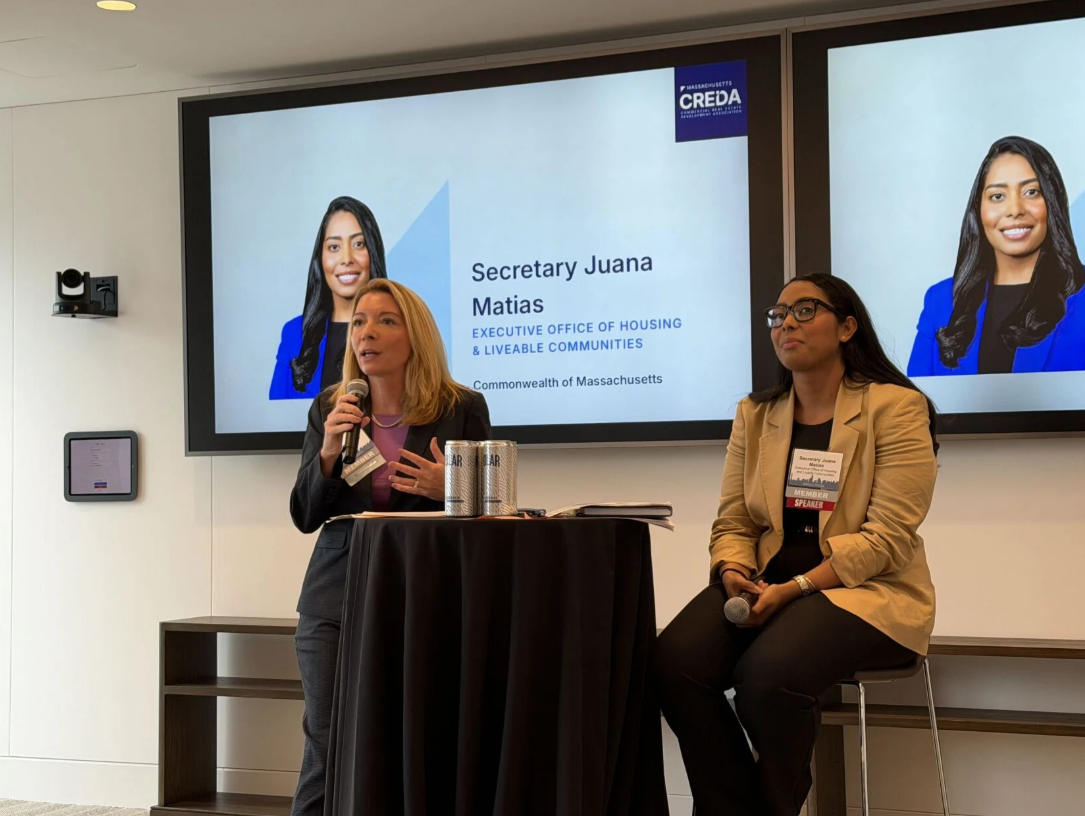
There are thousands of units are in the development pipeline in an attempt to tackle Massachusetts’ housing crisis, though the state’s top housing official says there needs to be “a gut and reality check” for how long the necessary amount will take to be built.
Housing Secretary Juana Matias has been on the job for six months and is “very excited” about site plan review reforms being considered in an economic development bill being negotiated by lawmakers.
“In terms of project feasibility and what we see would have the greatest impact, it’s site plan review. Nothing is more important than time and certainty when it comes to projects,” Matias told a room full of developers at a Commercial Real Estate Development Association event on Tuesday in downtown Boston. She said a local-option commercial conversion policy in negotiations is also among the administration’s priorities.
Gov. Maura Healey appointed Matias as secretary in February following the departure of Ed Augustus, who held the role since 2023. Matias represented Lawrence in the House for the 2017-2018 session before launching a run for Congress and later serving as New England regional administrator of the U.S. Department of Housing and Urban Development.
A statewide housing production tracker shows Massachusetts is about 15.6% of the way to reaching its goal of 222,000 units by 2035. The tracker, which the Executive Office of Housing and Livable Communities launched in June, shows that Massachusetts added 34,561 homes in 2025 and that the state still needs to produce 187,259 homes by 2035.
The crisis has permeated campaign season. Healey has called housing the “number-one issue facing the state” and thrown resources at the problem. Republican gubernatorial candidate Mike Minogue has said if he were elected governor he’d implement a plan to speed up housing construction timelines and relieve some budget pressures that are stressing municipalities. A recent MassINC Polling Group survey found that residents “still rank the Commonwealth among the best places in the country to live” but affordability is a major factor for those who are weighing whether to stay or put down roots elsewhere. Residents named cost of living, housing and taxes as top concerns that leaders should prioritize.
Matias didn’t have an answer as to how many units have been built so far in 2026, nor a figure for how many units the state plans to build by the end of the year. Matias spokesperson Kevin Connor said the state will be updating the tracker on an annual basis.
“We want to stay at par with what we saw in 2025, we don’t want to lose momentum. And so that’s the north star, right? When you’ve had such a great year, how do you keep that going moving forward?” Matias said.
A recent Pioneer Institute report shows that the state added 21,891 units to its housing stock between July 2025 and July 2026, according to the address count listing files from the U.S. Census Bureau. The report noted that the figure is “a marked slowdown in home completions” from 40,069 built between July 2024 and July 2025, which was 40,069, “but still faster than the overall pace of production since 2020.”
Through a program meant to build housing units on underutilized state-owned land, there’s the potential for more than 5,600 new homes to be built, Matias said. The state has also approved more than 2,000 accessory dwelling units since they were legalized by right, and a commercial conversion tax credit meant to turn underused office buildings into homes has supported nearly 1,200 units so far. The Housing Development Incentive Program, which aims to give so-called Gateway Cities a way to develop market rate housing, has so far begot 3,400 homes. There are 10,000 units in the pipeline under the MBTA Communities Law, which the Supreme Judicial Court ruled in support of on Sept. 18, affirming a lower court’s decision to dismiss a challenge by Marshfield.
The office is “actively drafting” regulations for a supplemental budget policy that implements sales tax relief for building materials for multifamily projects, Matias said. Her team is determining what eligibility and compliance for the program look like surrounding the $35 million per year the Legislature gave EOHLC to administer. MassDOT also last week approved $200 million for projects that “have some transportation component but unlock housing,” Matias said, adding that the state hopes to announce those projects “in the coming weeks.”
Matias flagged “Move-In Mass,” a new program that the state hopes to release “in the coming weeks” that’s modeled after a New York program called “Move-In NY.” The state is seeking responses to its request for information “to assist in the development of a potential pilot program to support the installation of manufactured or modular single family homes in the Commonwealth (Move-In MA) from municipalities that either own or have identified sites that may be well suited for such a program.”
She likened it to “a starter home initiative” meant to improve access to homeownership. The state wrote in its RFI that the “end result would be attractive single-family ranch-style homes in residential neighborhoods with existing public water and wastewater systems, or areas where infrastructure upgrades can be made in a reasonably economic way.”
While high housing costs in Massachusetts are driving away residents, those costs are impacted by high interest rates, inflation and tariffs that are making it more difficult to build, Matias added. The administration often bashes the Trump administration’s tariff policies, which President Donald Trump has put in place in various sectors as a way to improve the country’s “economic position.”
“I want to be straight with all of you. This work is going to take time,” Matias said during prepared remarks. “We have to look at Austin, Texas. Over 10 years, Austin added more than 120,000 homes. After that sustained growth, rent stabilized, and in some places, came down.” Massachusetts’s goal of building 222,000 new homes between 2025 and 2035 is almost twice Austin’s total, she noted.
“We are off to a very strong start. But to keep up the pace and go faster, we have to keep reforming the discretionary processes that, like good projects, get delayed or killed, including repeated hearings and endless lawsuits,” she continued.
Whether 222,000 units by 2035 is feasible is going to be driven by the private market, so federal actions will have a major impact on what the state is able to do, Matias said.
“Every new tariff is a tariff on a new home. It’s increasing costs, whether it’s, you know, lumber, steel, appliances,” she continued. “We need to be mindful [of] those things we can’t control for. But we’re going to continue to look inwardly on what we can control.”
Ella Adams is a reporter for the State House News Service and State Affairs Massachusetts. Reach her at ella.adams@statehousenews.com.

