Already a Subscriber? Log in
Get Instant Access to This Article
Subscribe to Worcester Business Journal and get immediate access to all of our subscriber-only content and much more.
- Critical Central Massachusetts business news updated daily.
- Immediate access to all subscriber-only content on our website.
- Bi-weekly print or digital editions of our award-winning publication.
- Special bonus issues like the WBJ Book of Lists.
- Exclusive ticket prize draws for our in-person events.
Click here to purchase a paywall bypass link for this article
For Mary Dean, president and CEO of Clinton Savings Bank, supporting good causes financially is inseparable from the bank’s role as a local institution.
But that means more than just writing a check.
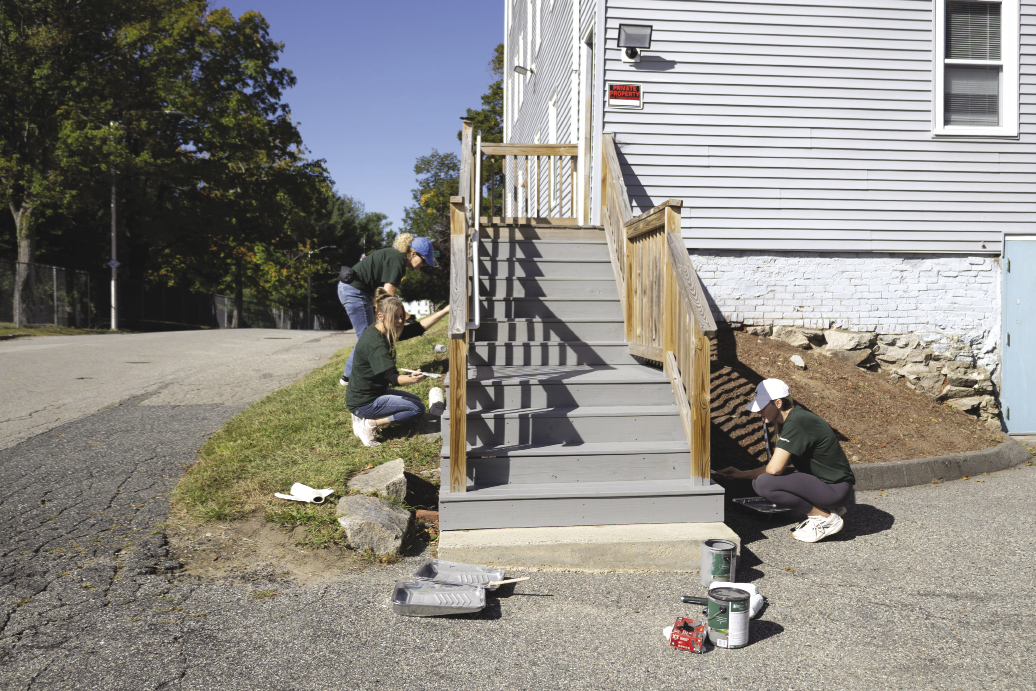
“Our employees are out there in the community volunteering for organizations that are near and dear to their hearts,” she said. “That type of volunteerism then creates a connection.”
Because employees across the bank’s branches know their communities’ needs, Dean said, they can invite small local organizations that might otherwise fly under the radar to apply for help. That means the bank ends up doing everything from donating to area hospitals to ensuring local families have enough food on their tables.
And the whole community can get in on the local pride. For example, it runs seasonal “Socktember” and “Socktober” drives at all its branches, where employees, customers, and other community members can donate socks to local women’s and veterans’ organizations. Other annual events include a back-to-school supply drive and a Christmastime toy drive.
Clinton Savings is not alone. Across Central Massachusetts, community banks are using their local connections and expertise to strengthen the region’s nonprofits, small and large.
Ed Augustus Jr., CEO of Whitinsville-based UniBank, said that being a mutual bank, which is owned by its customers rather than outside shareholders, means that supporting local groups is a crucial part of the mission.
“We can reinvest in the community that we draw our deposits from and create this kind of virtuous cycle,” he said. “The bank does better, and we’re able to invest more in the community. It really is part of who we see ourselves as. It’s not like some organizations that might be looking to take resources out of the community.”
To support its philanthropy, UniBank has been growing a foundation for the past several years, with a goal of reaching the $20 million range. Augustus said the foundation focuses mostly on contributions for capital investments. That means that, instead of supporting everyday operations, these funds go to things like expanding the physical space used for an educational program, allowing it to serve more children in the years to come.
At the same time, Augustus said, the bank makes direct contributions for other needs, including operational budgets. Those could be anything from sponsoring Little League teams to contributing to larger organizations' annual golf tournaments and galas.
In addition, UniBank’s local branches each have a budget for “random acts of kindness.” Teams of employees find ways to brighten up neighbors’ days, like stopping in to buy breakfast at a senior center, or for a town’s first responders.
Webster Five Cents Savings Bank, headquartered in Auburn, also uses a foundation for some parts of its philanthropic strategy while giving other contributions directly. President and CEO Brian Westerlind said one of the causes he’s proudest to support is the Worcester Community Action Council’s fuel assistance fund.
“It’s certainly an organization I know well, and one of those contributions that you know goes directly to folks that need it in our communities,” he said. “Our neighbors, in some cases family members and friends, people we went to school with.”
Alongside its philanthropic support, Westerlind said, Webster Five has developed a special focus on working with nonprofit banking customers.
“We have a couple of members of our commercial banking team who have a lot of years of experience serving nonprofits, which is a very distinct expertise,” he said. “It’s built up over time and we’ve really made it a focus over the past five years.”
He said another source of connection is that many bank employees serve on local nonprofit boards.
“It’s not just the leadership team members on those boards,” he said. “It’s really across the organization.”
Westerlind said this kind of service helps employees develop strategic and communication skills, and also gain a more rounded view of their communities.
M&T Bank, which is based in Buffalo, New York and has branches across Massachusetts, also works to connect financial support with employee engagement, according to Massachusetts Regional President Jeff Carpenter. He said all employees receive 40 hours of paid volunteer time.
Carpenter said that one particular focus since 2022 has been the Pan-Mass Challenge, a bike-a-thon supporting the Dana-Farber Cancer Institute. Every year, the bank organizes a team of riders, and other employees support fundraising and staff water stations during the event. This August, the M&T team of 30 riders and more than 70 volunteers raised more than $100,000.
“I ride for my mother and my sister, both cancer survivors who received lifesaving care at Dana-Farber, as well as a close friend who was recently diagnosed,” Carpenter said. “Their strength, resilience, and hope are constant reminders of why the Pan-Mass Challenge matters and why it is important that we keep showing up year after year.”
All the bank executives agreed that supporting local organizations matters on its own terms and is also a savvy move to keep local economies strong.
“We are not naive,” Dean said. “Providing this support is necessary. We are only as strong as the strength of the communities we serve. It’s in everyone’s best interests to be providing the donation dollars when we can, so we can all be successful.”

