Already a Subscriber? Log in
Get Instant Access to This Article
Subscribe to Worcester Business Journal and get immediate access to all of our subscriber-only content and much more.
- Critical Central Massachusetts business news updated daily.
- Immediate access to all subscriber-only content on our website.
- Bi-weekly print or digital editions of our award-winning publication.
- Special bonus issues like the WBJ Book of Lists.
- Exclusive ticket prize draws for our in-person events.
Click here to purchase a paywall bypass link for this article
Advanced military defense systems are manufactured in Marlborough, precision optics for fighter pilots are made in Westborough, and military headsets are produced in Worcester.
From major defense contractors to small manufacturers producing specialized components, Central Massachusetts companies play critical roles in the nation's military supply chain.
Those manufacturers are especially important as the U.S. government seeks to replenish stockpiles of weapons and military equipment to pre-Iran War levels, according to Kathie Mahoney, president of the Massachusetts Manufacturing Extension Partnership (MassMEP), a nonprofit part of a national network that supports small and medium-sized companies in the industry.
Mahoney emphasized the importance of the local defense industry supply chain, including the entities her organization supports with upskilling programs, process improvement and technology implementation.
Its APEX program, funded by the U.S. Department of War, helps manufacturers and other businesses navigate the procurement and certification processes.
In Massachusetts, the defense sector comprises more than 130,000 jobs, or about 8%, and generates $48.6 billion in annual economic output, according to MassMEP.
Worcester County had 35,100 people in the (nonfarm) manufacturing workforce (including all manufacturing), representing 9.8% of all local jobs as of August 2026, according to the Bureau of Labor Statistics.
Patriot missile production
“There are 4,000 parts in a Patriot missile,” Mahoney noted. “If any one of those parts is delayed or doesn’t meet quality standards, then production gets impacted. That’s where the supply chain comes into effect, contributing to the whole. Because all those parts are critical to the mission.”
Among the region’s largest defense contractors is Raytheon, a subsidiary of RTX, which has operations in Marlborough.
Last year, the U.S. Navy awarded Raytheon a $536.75 million contract for AN/SPY-6(V) air and missile-defense radar integration and production support, with the potential value of $2.886 billion if options are exercised. Raytheon would do 56% of that work at its Central Massachusetts location.
In February this year, the U.S. Army awarded Raytheon Marlborough a $22.8 million contract through 2031 to maintain and support SMART-T satellite communication systems.
Precision optics for fighter pilots
Another major local defense manufacturer is Kopin Corp.
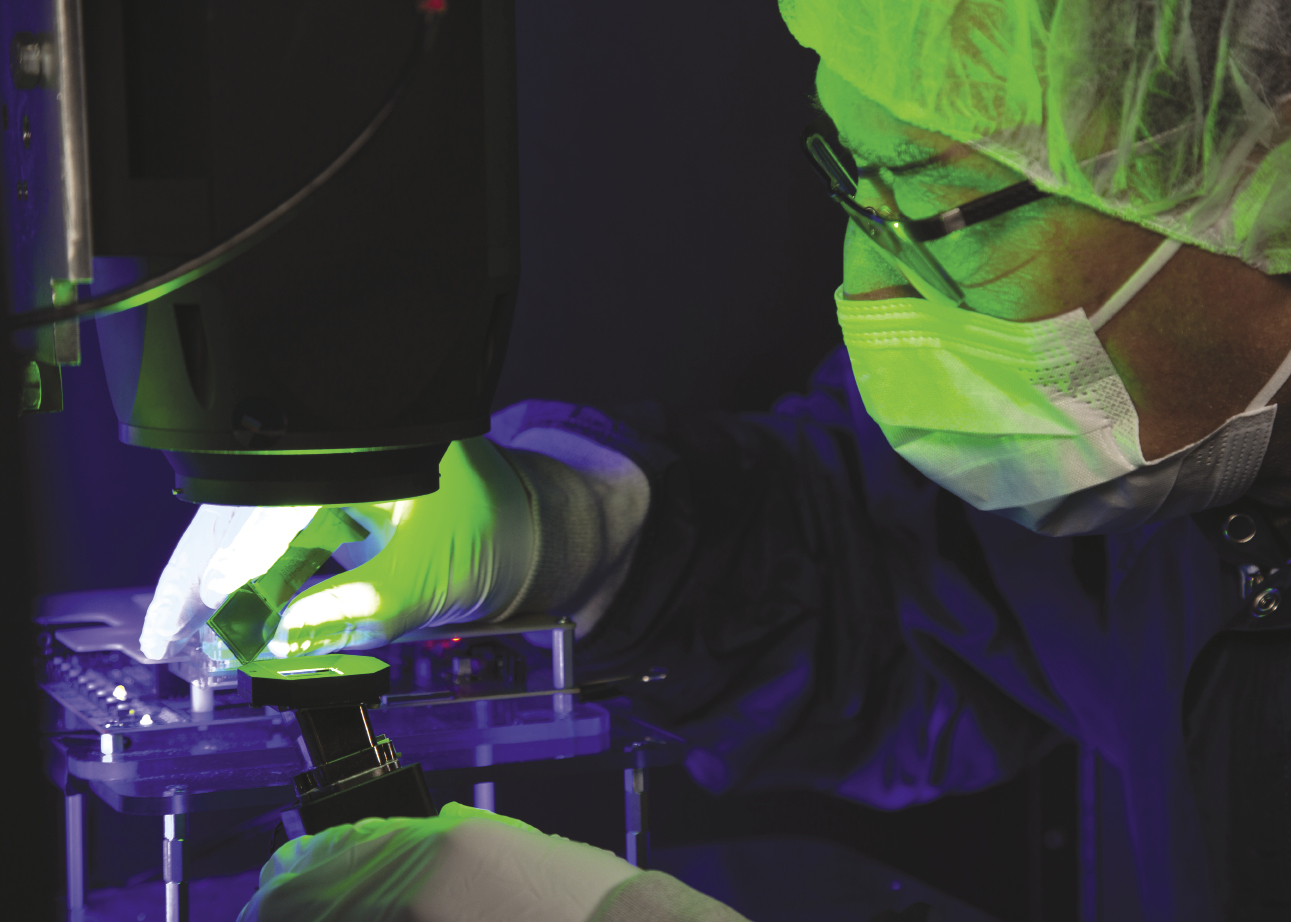
At its Westborough facility, Kopin develops and manufactures micro-displays and application-specific optical solutions.
“These are products that support human performance when the stakes are high and speed and accuracy matter the most,” said Kopin Chief Operating Officer Paul Baker.
Baker described a microdisplay as “a tiny, extremely high-resolution TV, about the size of a fingernail.” The display is built into a headset, where precision optics magnify the image and give the user detailed visual information.
Examples of Kopin’s products include the display used in fighter pilot helmets around the world and the weapon sights used by soldiers, which provide detailed information ranging from distance to a thermal profile to wind speed and more.
Baker noted displays are also used in the headset drone pilots wear “to effectively `put them in the driver’s seat’ of the drone.”
Surgeons also use its helmets and displays to see what surgical cameras (endoscopes) and microscopes are showing.
With $15 million in Department of Defense funding, Kopin is currently developing the technology and manufacturing process to make high-speed, low-energy, optical interconnect components for data centers.
The company’s other recently announced Department of Defense programs include:
$17 million to develop and establish domestic manufacturing capabilities for sophisticated micro-LED displays.
$21 million to manufacture critical eyepieces for a thermal weapon sight system.
$3 million to manufacture first-person view eyepieces for a USA drone manufacturer.
Hudson-based The Entwistle Co., founded in 1918, has supplied equipment to the U.S. military and select foreign militaries for more than 50 years. Its products include aircraft launch and recovery equipment, fueling systems and shipboard machinery, including jetblast deflectors that protect personnel and equipment on aircraft carrier flight decks.
Its padeyes, for example, allow Navy ships to transfer materials to and from supply ships.
The company received 146 new Department of Defense contract awards totaling $7.4 million in obligations in fiscal 2026, including $4.6 million attributed to Massachusetts. That followed $27.6 million in 2025 and $37.6 million in 2024.
Aviation headsets
Worcester-based defense contractor David Clark Co. manufactures aviation headsets, communication systems and life-support equipment for military and civilian applications.
The 91-year-old company received defense contracts totaling $15.2 million in fiscal 2026 for U-2 life support systems, with 98% of the work designated for Worcester. David Clark also supplied crew survival spacesuits for NASA's Artemis program.
But the regional defense supply chain extends well beyond its largest manufacturers. Smaller Worcester companies, such as D & T Fasteners and Powders on Demand, supply specialized components ranging from spring pins and fasteners to specialized powders and cold-spray additives.
Aircraft forgings to AR headsets
Dozens more defense contractors are in Central Massachusetts, including Wyman-Gordon of Worcester and Grafton, Precision Optics of Gardner, and IPG Photonics of Marlborough.
A defense and aerospace manufacturer founded in Worcester in 1883, Wyman-Gordon continues to produce specialized metal forgings for military and commercial aircraft at facilities in Worcester and North Grafton. The company, a subsidiary of Precision Castparts Corp., manufactures titanium, steel and nickel-alloy components used in aircraft structures and turbine engines.
Last year, Gardner-based Precision Optics secured a product development order worth $723,000 to produce components for an augmented reality headset used in U.S. Air Force fighter pilot training.
Marlborough-based IPG Photonics launched a high-energy laser defense system last year designed to tackle the growing threat of unmanned aerial systems. The device uses directed energy beams to disable drones and has applications for both military and private security uses.
Competitive advantage
The Worcester County workforce provides great value to defense-related advanced manufacturing, said Worcester Regional Chamber of Commerce President and CEO Timothy P. Murray.
“With precision manufacturing, you need high-quality, competent people given the significance of the work they do,” Murray said.
He noted the Department of Defense, for example, relies on these companies when it could go to lower-cost states to meet its supply chain needs.
“The work, the history of the workforce in this space is the difference,” Murray said.
Baker agreed, noting most of Kopin Corp.’s employees live in surrounding towns within a 20-mile radius of Westborough.
“We see our products supporting human performance when it matters most-whether it is for a surgeon or a soldier,” Baker said. “We want our customers to have the best equipment and tools available, so we are always pushing our product development capabilities and our quality.”
Manufacturers’ contributions to the economy are another benefit. Murray noted the average median wage is higher than two other large Massachusetts sectors—higher education and healthcare.
“What (defense manufacturers) create serves the supply chain and spending is extremely consequential in terms of materials, shipping and all the other logistics,” he said. “It’s just a high-value industry and sector on lots of different levels.”


