Already a Subscriber? Log in
Get Instant Access to This Article
Subscribe to Worcester Business Journal and get immediate access to all of our subscriber-only content and much more.
- Critical Central Massachusetts business news updated daily.
- Immediate access to all subscriber-only content on our website.
- Bi-weekly print or digital editions of our award-winning publication.
- Special bonus issues like the WBJ Book of Lists.
- Exclusive ticket prize draws for our in-person events.
Click here to purchase a paywall bypass link for this article
A streamlined permitting process and a single governing commission without layers of municipal review have expedited economic activity at Devens.
The former Army base supports thousands of jobs and billions of dollars in economic development, with major employers such as Commonwealth Fusion and Bristol Myers Squibb.
However, Devens is at a crossroads. Stakeholders are now trying to balance economic growth while the community expands housing options and considers the area’s future governance structure.
As a regional enterprise zone, Devens’ local regulatory and permitting authority is the Devens Enterprise Commission, consolidating reviews under one body. Meanwhile, cities and towns often require appearances before several municipal boards.
In 2025, it ruled on permit applications in an average of 51.5 days, below its 75-day statutory limit, while permitting or approving more than 780,000 square feet of development.
For MassDevelopment Executive Vice President Michael Sweeney, the broader formula is more complicated, combining economic development, housing, municipal services and relationships with the communities surrounding the 4,400-acre former Army base.
A former executive at Worcester-based law firm Fletcher Tilton, Sweeney was brought in by MassDevelopment in March to lead its efforts in Devens.
“There are a lot of complexities to Devens, but it works,” Sweeney said.
Devens’, now at over 1,700 residents and growing, faces a new phase. The area is adding housing after the state eliminated its longstanding cap on the allowable number of residences; officials are preparing a zoning proposal that could open another district to housing, and stakeholders are beginning to confront a 2033 deadline for recommending a permanent government.
As the future government issue emerges, questions remain about whether it will affect the ability to attract major employers, slow the permitting process, and raise business taxes and operating costs.
“We’ve got a really good thing going here and we don’t want to mess it up,”said state Sen. Jamie Eldridge (D-Marlborough).
An economic development model
A 2025 study commissioned by MassDevelopment counted 95 establishments employing 7,675 people at Devens. Including indirect and induced activity, the study estimated Devens supports nearly 16,700 jobs and contributes $7.9 billion in annual statewide economic output.
Its employers include Commonwealth Fusion Systems, which has its headquarters, manufacturing operations and a fusion research facility in Devens, and Bristol Myers Squibb, whose 89-acre campus supports biologics, cell therapy development and manufacturing.
Sweeney said Bristol Myers Squibb, CFS, and other large firms are expanding their Devens operations. MassDevelopment wants employers offering stable jobs, strong benefits and attractive salaries, he said.
The permitting system is central to that strategy. Sweeney called the DEC’s expedited review important and said businesses place a premium on consistent rules and predictable decisions.
He identified three other advantages: Devens’ tax structure, comparatively inexpensive utilities, and MassDevelopment’s ability to connect employers with financing and other state agencies.
Ayer Select Board Vice Chair Jannice Livingston, who also chairs the Devens Jurisdiction Framework Committee, said the system has benefited the wider region.
“The permitting process out of the DEC is wonderful, and is certainly something that my town is looking into, and other towns should obviously look into too,” Livingston said.
Building a residential base
Until recently, housing played a limited role in Devens’ redevelopment. The state Legislature removed the community’s 282-unit cap in November 2024, opening already-zoned land to additional residential construction.
Projects now moving forward include 12 for-sale homes in six duplexes at Adams Circle and 46 mixed-income apartments at 77 Grant Road. MassDevelopment also selected Newton-based Metro West Collaborative Development to negotiate the purchase of another Adams Circle site for 65 apartments affordable to households earning between 30% and 80% of area median income.
Sweeney said employers regularly hear from workers looking for homes in Devens or nearby to shorten their commutes. The new projects are intended to offer a mix of ownership and rental opportunities at different prices, he said.
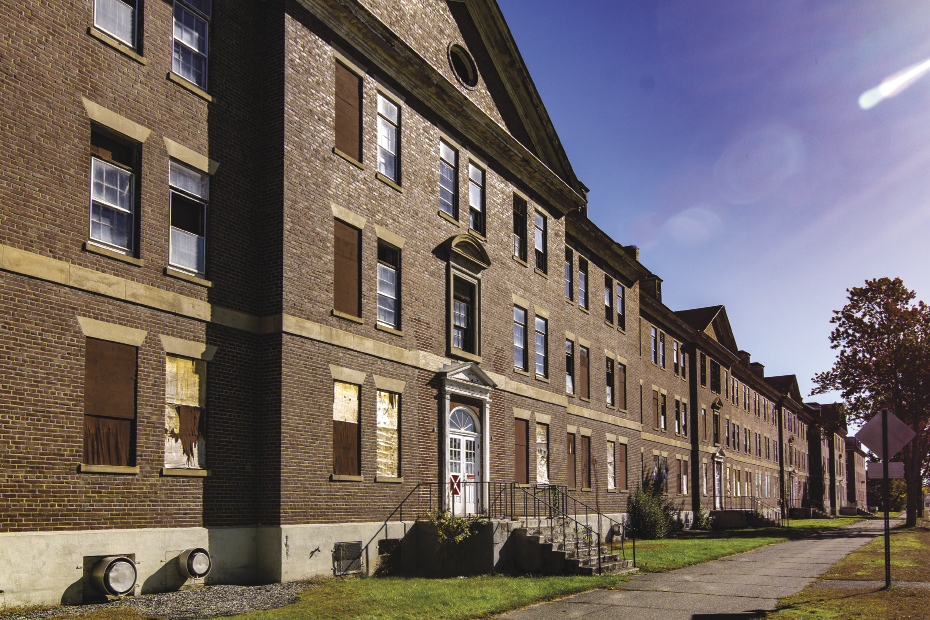
A larger opportunity sits in the roughly 90-acre Innovation and Technology Center district, which includes the vacant former military barracks at Vicksburg Square. A state-created working group recommended amending the zoning to permit apartments, townhouses, duplexes, cottages, and other housing there while retaining the possibility of commercial development.
Sweeney said MassDevelopment plans to ask voters in Ayer, Harvard and Shirley to consider the amendment at simultaneous town meetings in March 2027. Each community must approve the same zoning language.
Livingston supports housing at Vicksburg Square, perhaps an adaptive reuse project if the historic buildings can be utilized safely. She said a capable developer could make Vicksburg a real place of pride, but wants public forums before the vote so residents understand the proposal and its potential effects.
Housing and commercial growth must also coexist with Devens’ recreational role; Sweeney said more than 320,000 people visited last year, with attractions that include sports fields, the Devens location of Clinton-based Sterling Street Brewery and a disc golf course. Protecting and improving those resources as development continues is one of his priorities, he said.
Devens also remains home to an active military presence, and Sweeney said MassDevelopment has begun monthly meetings with the base to explore partnerships on issues including energy and procurement.
What happens by 2033
The 2033 deadline comes from Chapter 498, the state law that established Devens’ redevelopment structure. The law requires the DEC, MassDevelopment, and the select boards of Ayer, Harvard and Shirley to begin studying permanent-government options by July 1, 2030, and submit a study and joint recommendation to the governor and Legislature by July 1, 2033.
In practical terms, the stakeholders must decide who should govern Devens over the long term and how its services, infrastructure, assets and costs should be handled. The law directs them to consider structures involving the towns, joint entities, MassDevelopment and the DEC; identify transition costs and needed investments; and seek public participation.
State lawmakers would still have to decide whether to enact the recommendation, while also addressing MassDevelopment authorities that are expressly scheduled to expire in 2033, including its designation as Devens’ industrial development financing authority and certain regulatory powers related to public health, welfare and safety.
No consensus exists on the outcome. Eldridge said the surrounding towns have historical and financial interests. Some residents favor greater local control or an independent town, and businesses generally value the present system.
From the business perspective, Eldridge said, there’s interest in a system that prioritizes expedited economic development.
The Devens Jurisdiction Framework Committee has been assembling information about options, including continued state management, restoration of the historic town boundaries, an independent Devens or hybrid arrangements.
Livingston, who chairs the committee, said MassDevelopment’s return to the discussions under Sweeney has improved communication.
“MassDevelopment is back at the table, which is a good thing,” she said. “That means they’re part of the conversation. They’re listening to what’s going on.”
Sweeney said MassDevelopment’s immediate responsibility is to remain a consistent steward, keep Devens’ day-to-day operations running, and communicate openly with municipal officials. The agency maintains roads and recreational fields, operates utilities, provides fire and emergency medical services, and contracts with the Massachusetts State Police for policing.
“It’s like a good referee,” Sweeney said of MassDevelopment’s role. “When good referees are really doing their job, you don’t really notice them.”
The long-term challenge is to make any governance change just as unobtrusive: preserving reliable services, predictable permitting, and business confidence while creating room for more homes and a larger residential voice.
Those elements helped Devens move beyond its military past, and stakeholders must decide which parts of the model are essential to its future.
